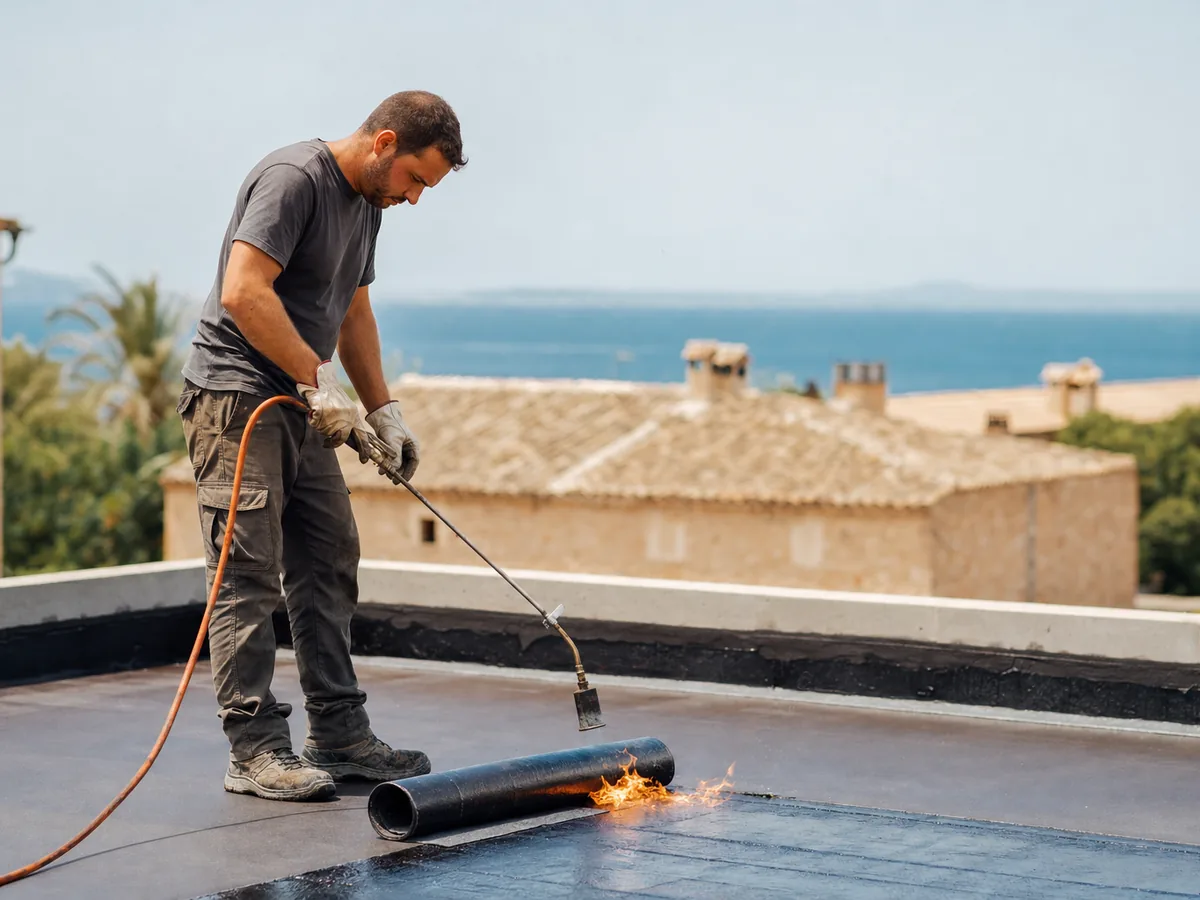
Waterproofing a terrace in Mallorca costs between €20 and €50/m² in 2026, depending on the system: €22-35/m² with SBS asphalt membrane, €25-45/m² with continuous liquid membrane, and from €30/m² with sprayed polyurethane. For walkable terraces, the cost of the paving must be added. A well-executed waterproofing lasts between 15 and 25 years; a poorly done one, two winters.
The damp that shows up on the living-room ceiling almost never comes from where the owner thinks. It comes from the terrace above, from a gully that has been blocked for three summers, or from a junction between the paving and the parapet that has been open for years. And in Mallorca the cycle is relentless: forty degrees in August that make the materials expand, salt air that attacks the mortar, and then an October downpour that dumps eighty litres in two hours.
How much does it cost to waterproof a terrace or roof in Mallorca?
Between €20 and €50/m² in 2026, depending on the chosen system and the condition of the substrate. On a standard 40 m² terrace, this means an investment of €800 to €2,000 just for waterproofing, plus the cost of demolishing the existing paving and laying new flooring if the terrace is walkable.
| System | Price 2026 | Indicative lifespan |
|---|---|---|
| SBS or APP asphalt sheet | 22 – 35 €/m² | 20-25 years |
| Continuous liquid membrane | 25 – 45 €/m² | 10-15 years |
| Sprayed polyurethane | 30 – 50 €/m² | 15-20 years |
| PVC or TPO sheet | 30 – 45 €/m² | 20-30 years |
| Demolition of the existing floor finish | 12 – 20 €/m² | — |
| New non-slip floor finish | 30 – 60 €/m² | — |
The range is an honest one: where the final price is really decided is in the detailing and junctions, and we come back to that further down.
Which waterproofing system is suitable for the type of terrace?
It depends on whether the terrace is walkable, whether the paving can be lifted, and the geometric complexity of the surface. There isn't one system that's inherently better than another; there's a system that's suitable for each specific situation.
- Accessible terrace above the dwelling: two-layer asphalt membrane under the paving, the most durable solution and the one that best complies with Basic Document HS-1 of the Technical Building Code.
- Non-trafficable flat roof: self-protected membrane or PVC. It is laid exposed, with no paving over it, and works out cheaper.
- Terrace with many elements and meeting points: continuous liquid membrane. Having no joints, it deals well with corners, gullies and railing feet.
- Roof with insufficient insulation: sprayed polyurethane, which waterproofs and insulates in the same operation.
- Terrace above commercial premises in Palma: asphalt sheeting with reinforcement, because the failure here has immediate economic consequences for the business below.
How can you tell if a terrace needs waterproofing or just a repair?
You repair when the failure is localised and the rest of the surface still has the membrane in good condition. You waterproof the whole thing when damp shows up at several points on the ceiling below, when the paving is lifted or bulging in different areas, or when the last intervention is more than twenty years old.
These are the signs we see before recommending a full intervention:
- Damp patches in more than one spot on the ceiling of the lower floor.
- Hollow or bulging tiles when stepped on.
- Open joints and crumbling mortar around the drains.
- White efflorescence on the ceiling or on the parapet of the terrace.
- Water that appears days after it rains, not during.
- Ceiling paint peeling off in sheets.
That fifth point is the most revealing. If the stain appears 48 hours after the storm, there is accumulated water inside the slab. That's no longer a localized leak: it's a deposit.
Is it possible to waterproof a terrace without lifting the paving?
Yes, with liquid membranes applied over the existing floor, provided the subfloor is firm and moisture hasn't accumulated beneath it. It's faster and cheaper, but there's one non-negotiable condition: if water is trapped in the slab, sealing it from above will only worsen the problem.
We explain it on site with a simple image. Waterproofing over trapped water is like putting a plaster over an infected wound: it looks fine from outside and it keeps getting worse underneath. That is why, before proposing this solution, we check the real condition of the substrate. If we find saturation, the recommendation is to lift it, dry it and do it properly. We tackle the underlying problem the same way as in our guide on how to protect your house in Mallorca from damp.
Why do so many terraces fail in Mallorca?
Because of the combination of extreme thermal movement, salt in the air and concentrated torrential rain. A terrace on the island can go from 15 °C at dawn to over 60 °C of surface temperature at midday in summer, and that continuous movement opens the joints and fatigues the materials.
Add to that two very specific local factors. The first is salt air: on the beachfront, in Palma, Cala Ratjada, or Port de Pollença, it attacks mortars and metal anchors with an aggressiveness not found inland. The second is the design of the drains: many buildings from the 1960s and 70s have a single drain for an entire terrace, without an overflow. When that drain becomes clogged with leaves or sand, the terrace turns into a pool, and the water finds its weak point.
How long does waterproofing last and what maintenance does it need?
Between 15 and 25 years, depending on the system, provided two simple inspections are carried out annually. Actual terrace maintenance takes fifteen minutes in spring and fifteen in autumn: cleaning drains, checking perimeter joints, and verifying the parapet and railing finishes.
This maintenance prevents most of the emergency repairs we have to do. Seriously: if we had to choose just one piece of advice from this article, it would be to check the drain before the first heavy rain in October.
Who pays for the waterproofing of a terrace in a homeowners' association?
If the terrace is part of the building's roof, even if it is for private use, the waterproofing is the responsibility of the community, because it forms part of the common elements according to the Horizontal Property Law. The owner of the private use assumes responsibility for the paving and ordinary maintenance.
It is one of the most common arguments at residents' meetings in Palma, and it usually gets settled badly through lack of knowledge. The rule of thumb: the waterproofing membrane that protects the slab is communal; the finish the user walks on is not. If your case is a communal job, you will be interested in our page on refurbishment works in residents' associations in Mallorca.
Why have Construcciones Armalutx do the waterproofing
We're a construction company, not installers. That means that when we open up a terrace and find a damaged slab, a parapet without a lintel, or a poorly installed gutter, we know how to fix it and include it in the quote, instead of just patching it up and disappearing.
Since 1967 we have delivered over 1,500 projects in Mallorca, and a significant part of our current work is water-related defects in buildings from the 1960s and 70s. We work to a fixed quote and with our own crews, with a guarantee on the work carried out.
When NOT to waterproof a terrace
- When the moisture comes from the facade or a pipe, not from above. Sealing the terrace will change nothing and you will have spent the money in the wrong place.
- When the terrace is saturated with water and there is a hurry to close. Waterproofing over a soaked slab guarantees that the problem comes back.
- When the building is scheduled for a complete renovation next year. Wait and do it all at once: scaffolding and finishing touches can be used.
Frequently asked questions about waterproofing terraces in Mallorca
How much does it cost to waterproof a 40 m² terrace in Mallorca?
Between €800 and €2,000 for the waterproofing alone, depending on the system. If the existing paving has to be demolished and a new one laid, the realistic total sits between €2,500 and €5,000. The quote varies above all with the linear metres of detailing: parapets, steps, columns and gullies push the price up more than the flat area does.
How long does it take to waterproof a terrace?
A standard 40 m² terrace can be finished in four or five working days if the existing paving doesn't need to be removed, and in two or three weeks if it's demolished, the subfloor is prepared, and new paving is laid. Liquid membranes require curing time between coats, and this period cannot be accelerated without compromising the result.
Is it possible to waterproof a terrace in winter in Mallorca?
Yes, but with conditions. Liquid systems and polyurethane require a dry surface and temperatures above 5°C, which is common on the island even in January. The problem isn't the cold, but the ambient humidity and rain: if the substrate doesn't dry, it can't be applied, and in winter the working windows are shorter.
What guarantee does a terrace waterproofing have?
The Building Regulations Act sets a three-year guarantee for defects affecting habitability, and water leaks fall squarely into that category. Manufacturers of asphalt membranes and PVC systems also offer product guarantees of between 10 and 15 years, provided the installation is carried out by a qualified company and the maintenance is kept up.
Request a quote to waterproof your terrace
If you have stains on your ceiling, hollow tiles, or a terrace that hasn't been touched in twenty years, the first step is an honest diagnosis of where the water is really coming in. We'll check it out and give you a fixed price quote. If the problem is with a pitched roof, we can address that on our website roof renovation in Mallorca.
Call us at 625 16 47 18 or write to us at info@armalutx.com. We are a construction company in Mallorca with over 50 years and we also carry out full home renovations in Mallorca .