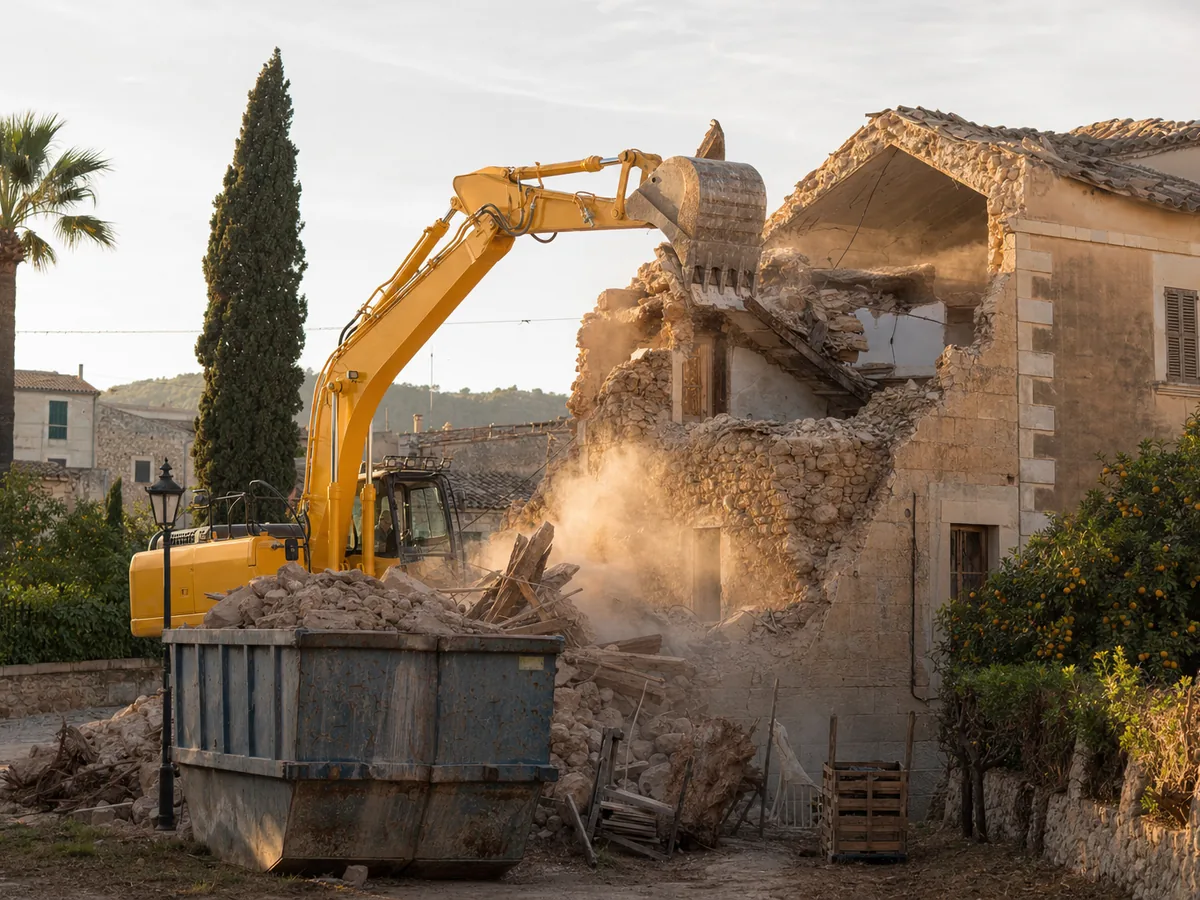
Demolishing a house in Mallorca costs between €50 and €100/m² in 2026, plus around €25/m³ for rubble disposal and the demolition design, which comes to between 6% and 15% of the construction cost. A municipal demolition permit is required, and if the roof is fibre cement, the asbestos removal has to be done by a company on the RERA register. Careful: demolishing can cost you the right to rebuild the same volume.
Before discussing prices, it's important to mention the key points, because ignoring them is what costs the most money: in Mallorca, demolishing a house does not always give you the right to put up another one the same. If the building is non-compliant with zoning regulations or located on rural land, the existing volume may be irreplaceable. We've seen homeowners demolish a 300 m² house only to discover later that current regulations only allow them to build 180 m².
Checking it costs a planning consultation. Not checking it can cost a third of the property's value.
How much does it cost to demolish a house in Mallorca?
Between €50 and €100/m² built in 2026, depending on the demolition method and accessibility. To that must be added waste management, around €25/m³, the technical project, and licensing fees. For a 200 m² house, the realistic total cost ranges from €18,000 to €35,000.
| Item | Cost 2026 |
|---|---|
| Demolition with heavy machinery | ~€60/m² |
| Manual or selective demolition | ~50 – 100 €/m² |
| Mixed demolition (machine + manual) | from €15/m² |
| Rubble disposal at an authorised facility | ~€25/m³ |
| Demolition project | 6 % – 15 % of the PEM |
| Municipal permit fees | 3 % – 6 % of the PEM |
| Asbestos removal | 8 – 25 €/m² additional |
| Asbestos work plan | €300 – €600 |
On an island, waste disposal costs more than people expect. Construction debris doesn't leave Mallorca: it's managed at plants on the island itself, and their capacity and rates determine the final price.
What permits are needed to demolish a house in Mallorca?
A municipal demolition permit is needed, which is a major works permit and calls for a technical design drawn up by an architect or building surveyor, a health and safety study and a waste management study. On listed buildings, heritage authorisation is needed as well, and it is often refused.
The usual documentation requested by a town hall in Mallorca:
- Demolition project with report and plans of the current state.
- Study of construction and demolition waste management.
- Basic health and safety study.
- Designation of the technical director of the demolition.
- Certificate of absence of asbestos or, failing that, approved work plan.
- Proof of payment of municipal fees.
And a word of caution about the timeframes: between application and approval, it usually takes two to four months. The demolition itself can take a week; the paperwork, three months.
Does demolishing a house give you the right to build another one just like it in Mallorca?
Not always, and this is the most important question in the whole process. If the building is non-compliant—built legally under a previous, more permissive regulation—demolishing it means losing the consolidated volume, and the new construction must comply with the current urban planning parameters, which are almost always more restrictive.
On rural land the matter is even more delicate. An existing dwelling may have its use recognised through age, and demolishing it can mean losing that recognition with no way of getting it back. Before touching anything it is worth checking the specific planning status of the plot with the town council and the Consell de Mallorca, and check the rural land regime laid down by the Government of the Balearic Islands. We discussed this in our article on whether whether it is possible to build on rural land in Mallorca.
When the current volume exceeds the limits allowed by current regulations, the alternative is usually to renovate rather than demolish. The structure and building envelope are preserved, and everything else is renovated.
What happens to asbestos when a house is demolished?
If the property has fibre cement from before 2002 — uralite roofs, downpipes, tanks — it contains asbestos and its removal must be carried out by a company on the Register of Companies with Asbestos Risk, with a work plan approved beforehand by the labour authority.
It costs between €8 and €25/m² extra, and the work plan between €300 and €600. It is not a formality you can skip: handling asbestos without authorisation is a serious breach of health and safety law under Royal Decree 396/2006, with penalties that far outweigh the savings. In Mallorcan homes built between the 1960s and 1990s, it is such a common feature that it should be taken for granted until proven otherwise.
How is demolition debris managed in Mallorca?
With selective separation on site and delivery to an authorised treatment plant on the island, together with the corresponding certificate. The waste management study forms part of the design, and the town council may require a bond that is returned once correct delivery is evidenced.
What's usually surprising is the volume. A 200 m² home easily generates between 200 and 300 m³ of waste, and at €25/m³ the management bill is around €5,000-€7,500. Proper separation—concrete on one side, ceramics on another, metals separately—reduces that figure, because the rates vary depending on the material.
How long does it take to demolish a house?
The demolition of a single-family home takes one or two weeks with machinery, and three or four weeks if done manually or selectively based on proximity to party walls. The entire process, including permits, usually takes between three and five months.
In Palma and in the village centres there is an added constraint: occupying the public highway for skips and machinery needs its own permit, with restricted hours. And in tourist municipalities, restrictions on building work in high season can block the calendar between June and September.
Is it better to demolish or rehabilitate?
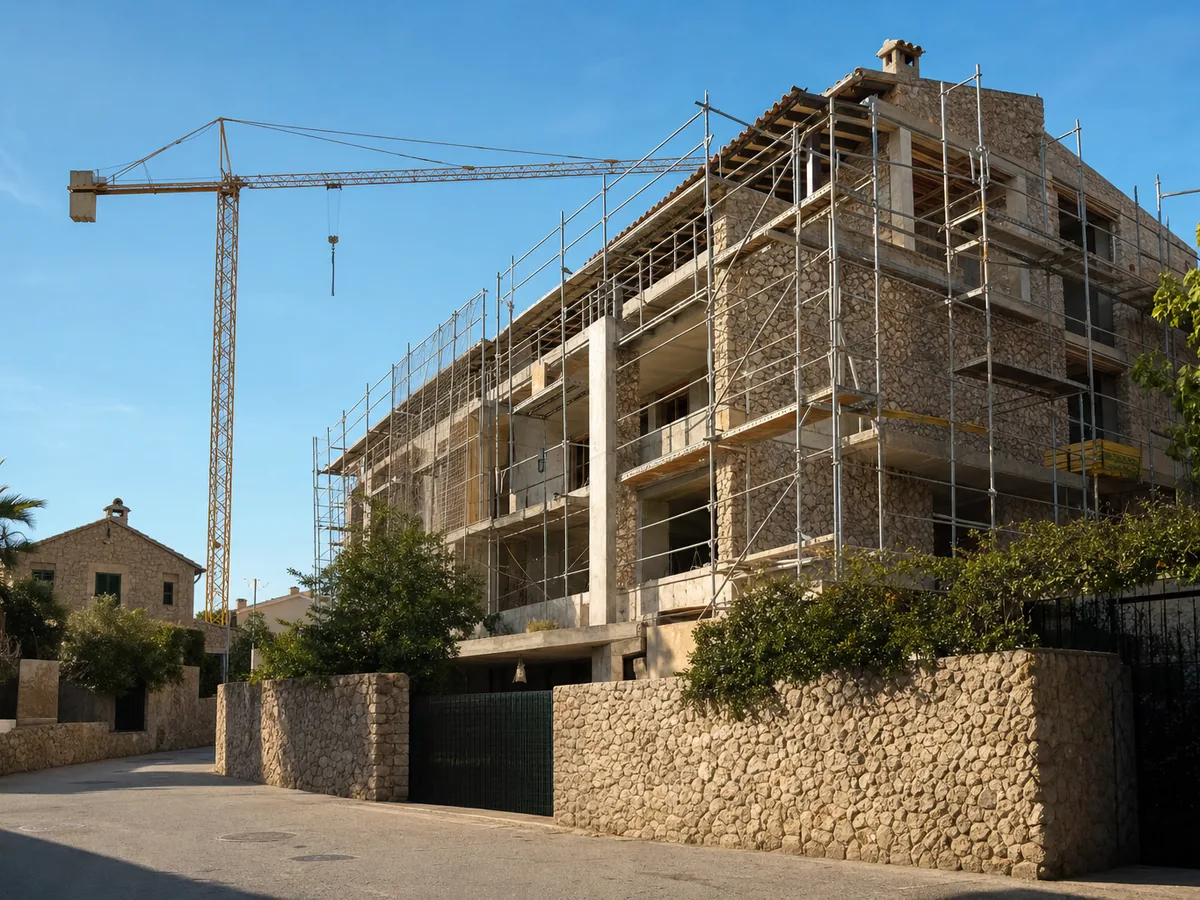
Demolition is advisable when the structure is beyond repair, the layout is irreparable, and regulations allow for rebuilding the same volume or more. Rehabilitation is advisable when the building has a consolidated volume greater than current regulations permit, or when the property's heritage value is part of what you purchased.
| Factor | Demolition and new construction | Rehabilitation |
|---|---|---|
| Buildable volume | It complies with current regulations | The existing one is kept |
| Cost per m² | Higher on a full new build | Variable depending on state |
| Total timescale | 18-30 months | 8 – 14 months |
| Result | Home 100% made to measure | Conditioned by what exists |
| Urban planning risk | High if the building is non-conforming | Low |
If you're unsure between the two options, we have an article dedicated to that: full renovation or new build, which one suits your case.
When NOT to demolish a house in Mallorca
- When the building is listed. In protected buildings, demolition is prohibited or limited to specific elements, and requests for it usually end in denial.
- When the current volume exceeds what the current planning allows. You would be giving away buildable square metres you will never get back.
- When the structure is recoverable. If the load-bearing walls and the floor structures are sound, stripping out the interior and refurbishing works out faster and cheaper than starting from scratch.
Frequently asked questions about demolishing a house in Mallorca
How much does it cost to demolish a 200 m² house in Mallorca?
Between €18,000 and €35,000 in 2026, including demolition, waste disposal, technical design and municipal fees. If the roof is fibre cement with asbestos, add between €8 and €25/m² for specialist removal. The final price depends above all on access: a terraced house in a village centre costs considerably more than a detached one with vehicle access.
Can a house without a permit be demolished in Mallorca?
No. Demolishing a building always requires a municipal permit, and carrying it out without one constitutes a planning violation that can result in a fine and, on protected land, the obligation to restore the altered physical state. Furthermore, without a permit, it will not be possible to process any subsequent new construction or to remove the property from the land registry.
What happens with the cadastre and the Land Registry after demolishing a house?
The demolition must be declared to the Spanish Cadastre electronic office to stop paying taxes on a building that no longer exists, and to issue a deed of declaration of new construction due to demolition in order to update the Property Registry. These are post-construction procedures that many people forget and that cause problems when selling the plot.
Is it possible to demolish only part of the house?
Yes, it is what is known as partial or selective demolition, very common when the facade is kept on heritage grounds or when an unauthorised extension is taken down. It still needs a permit, and it usually works out more expensive per square metre than full demolition, because it is done by hand and with shoring so as not to compromise what stays standing.
How long does the town council take to grant the demolition permit?
Between two and four months in most Mallorcan municipalities, counting from the complete submission of the design. It takes longer if the property is in a listed setting, if it needs a sector report from the coastal or highways authority, or if the town council asks for extra documentation, which happens fairly often.
Before you demolish, let's talk about what you will be able to build
At Construcciones Armalutx we have been building and demolishing in Mallorca since 1967, and the advice we give free most often is the same: check first what they will let you put up. We go through the planning status of the plot with you, weigh up whether demolishing or refurbishing is worth it, and give you a fixed quote for the whole operation.
Call us at 625 16 47 18 or write to us at info@armalutx.com. We are a construction company in Mallorca with our own team, and if in the end the path is new construction, we execute it entirely as construction company for new builds in Mallorca.