Enclosing a terrace in Mallorca costs between €250 and €600/m² depending on the material, which puts a 15 m² terrace between €3,400 and €6,000 in 2026. A municipal permit is needed — without it the enclosure is illegal even if the neighbours approve it — as well as an agreement from the residents' association, usually by three-fifths. And there is one detail almost nobody checks: enclosing the terrace can count as built area and use up buildable allowance.
Enclosing a terrace seems like the most harmless renovation in the world. You gain a room, the house is better insulated, and it can be done in two days. And yet, it's one of the projects that generates the most urban planning enforcement cases in Mallorca, along with undeclared swimming pools. The reason is always the same: they do it first and ask questions later.
Is it possible to enclose a terrace in Mallorca?
You can, provided the town's planning rules allow it, the residents' association authorises it if it affects the facade, and the corresponding municipal permit is obtained. The three conditions are cumulative: failing one invalidates the whole job.
What many owners do not know is that the order matters. The residents' agreement does not replace the permit, and the permit does not replace the residents' agreement. And without checking the planning rules first, you can get both and still find the job unfeasible.
What permits are needed to enclose a terrace?
Two separate authorisations are needed: the agreement of the owners' meeting, normally by a three-fifths majority since it involves altering a communal element under the Horizontal Property Law, and the municipal permit, which depending on the scope will be a self-certification, minor works or major works with a technical design.
- Check the municipal planning rules and the residents' association regulations.
- Take the proposal to the owners' meeting and obtain the agreement with the required majority.
- Commission the design or the technical report according to what the town council asks for.
- Apply for the permit and pay the fee, between 2% and 6% of the construction cost.
- Carry out the work as authorised, with no changes as you go.
- Declare the change in the Spanish Cadastre electronic office if the built area has been modified.
Without a municipal permit the enclosure is illegal even if the residents' association approved it unanimously. The agreement between residents settles the civil side, not the administrative one.
How much does it cost to enclose a terrace in Mallorca?
Between €250 and €600/m² in 2026 depending on the system and the quality of the profile. A 15 m² terrace with an aluminium enclosure comes to between €3,400 and €4,000, and with a thermal break and high-performance glass it can reach €9,000.
| Type of enclosure | Price 2026 |
|---|---|
| Aluminium without a thermal break | 250 – 450 €/m² |
| Aluminium with a thermal break | 350 – 600 €/m² |
| Glass curtain without vertical profiles | 300 – 550 €/m² |
| Typical terrace of 15 m² (turnkey) | €3,400 – €6,000 |
| Municipal fees | 2% – 6% of the construction cost |
| Technical project (if required) | 500 – 1,500 € |
In Mallorca, a thermal break is not an optional extra. A south-facing enclosed terrace with no solar control turns into a greenhouse from June to September, and you end up spending on cooling what you saved on the joinery.
Does enclosing a terrace count as built area?
It usually does count, and it is the consequence that surprises people most. If the enclosure is fixed and creates a covered, closed space, in most municipalities it counts as built area for buildable-allowance purposes, which means updating the cadastre and, as a result, paying more council tax.
This has two important implications in Mallorca:
- If the building has already reached its maximum buildable area, the town council can refuse the permit outright, however much the residents' association agrees.
- If you are looking to gain floor area properly regularised, perhaps what you want is not an enclosure but a well-planned house extension in Mallorca .
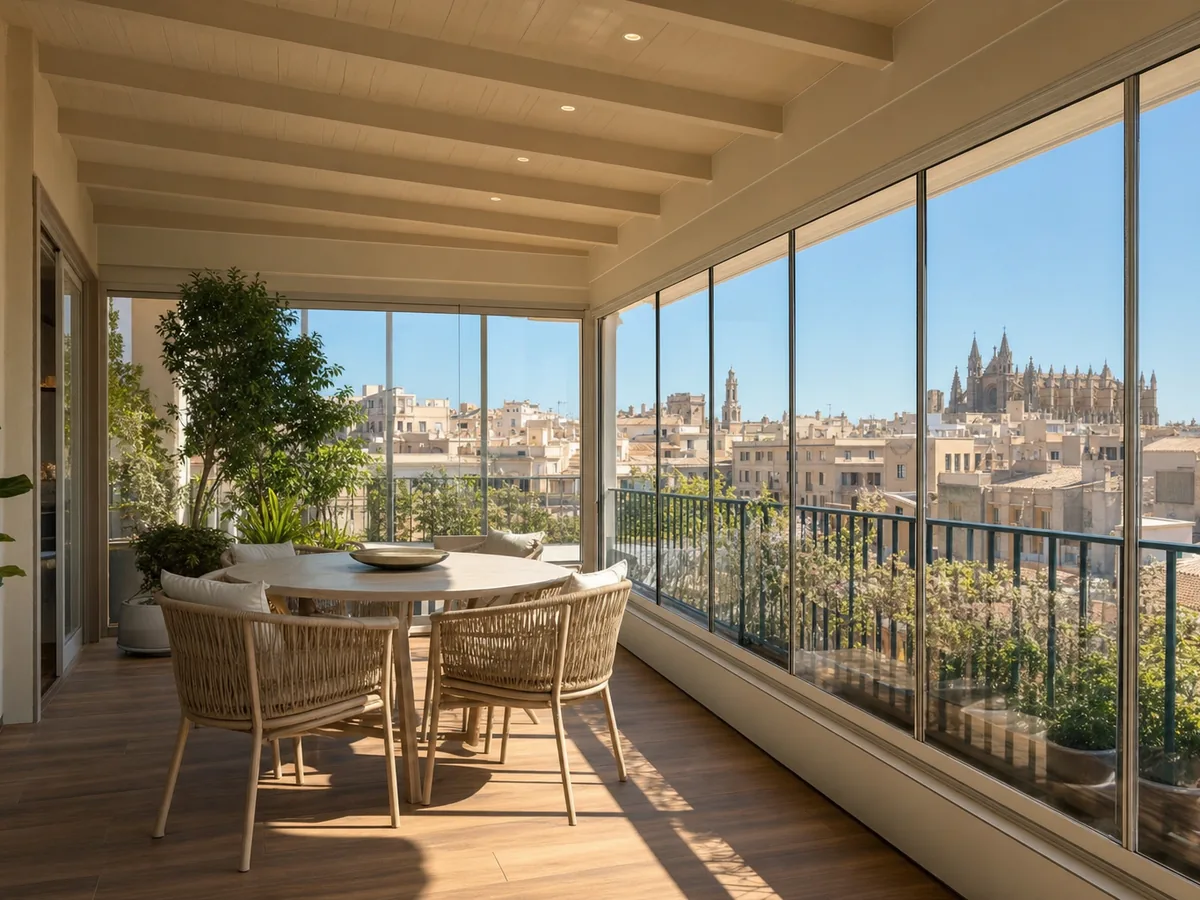
There is a relevant nuance: folding, fully openable enclosures of the glass-curtain type are treated in some municipalities as glazing rather than as an enclosure, precisely because they do not create a permanently closed volume. It is a common route, but it varies from one town council to another and it is worth confirming before buying anything.
What happens if I enclose the terrace without a permit in Mallorca?
A planning enforcement file is opened, with a fine and an order to reinstate, that is, the obligation to remove the enclosure at your own cost. On top of that, unlegalised work will show up on the land registry extract and will complicate selling or mortgaging the property.
There is a statute of limitations for legal action to restore legality, but in Mallorca, it's best not to be complacent: on protected land and in listed areas, the infraction does not expire. And even if the statute of limitations does expire, the construction remains non-compliant, which restricts any subsequent renovations and negatively impacts the property's appraised value.
Is it possible to enclose a terrace in a listed building?
In listed buildings or protected historic districts, enclosures are often denied because they alter the appearance of the facade. In Palma, Sóller, Pollença, and Valldemossa, the heritage commission is particularly restrictive regarding any modifications visible from the street.
In these cases, there is leeway on interior facades or hidden courtyards, always with a prior favorable report. It's worth consulting before investing in a project: the heritage criteria are known through a prior consultation, and knowing this beforehand saves a considerable amount of money. The applicable regulations are published by Consell de Mallorca together with each town council.
Does enclosing the terrace increase the value of the property?
It adds value if it is legalised and well executed, and it takes value away if it is not. A terrace enclosed with a permit and registered at the cadastre adds real usable square metres to the property; one enclosed without paperwork subtracts value, because the buyer and their bank will find the discrepancy at valuation.
It is exactly the same criterion that we apply to any work: what is not in order does not count as value, it counts as risk.
When NOT to close the terrace
- When the building has used up its buildable allowance. They are not going to give you a permit, and doing it anyway exposes you to enforcement.
- When the terrace is the only outlet for smoke or ventilation from the kitchen. Closing it off can leave the home outside the habitability regulations.
- When you plan to sell in the short term and you're not going to legalize it. You will lose more at valuation than you put into the work.
- When it is the roof of the neighbour below and you have not sorted out the waterproofing. Closing over a water problem hides it, it doesn't fix it.
Frequently asked questions about enclosing a terrace in Mallorca
What majority does the community need to authorize the closure of a terrace?
Usually three-fifths of the owners and of the shares, since it involves altering the facade, which is a communal element. Some associations have a specific regime in their statutes that allows enclosures following a previously approved standard model, and in that case it is enough to stick to it and notify them.
Can I enclose the terrace if other neighbors have already done so?
Not automatically. The fact that there are earlier enclosures does not create a right, and many of them may be unlegalised. What can happen is that the association has approved a standard enclosure model; in that case, sticking to that model makes the neighbours' authorisation much easier, although you will still need the municipal permit.
How long does the town council take to grant the permit to enclose a terrace?
Between one and three months in most municipalities of Mallorca if processed as a minor works project or self-declaration. If the town hall requires a technical project or the property is in a protected area, the timeframe can extend to four or six months due to the heritage report.
Do you have to pay more property tax after enclosing a terrace?
Yes. When the enclosure counts as built area it has to be declared at the cadastre and the rateable value of the property goes up, which means a higher council tax bill. The increase is usually moderate, but leaving the cadastral declaration undone is a tax offence separate from the planning one.
Is enclosing a terrace the same as installing a bioclimatic pergola?
No. A bioclimatic pergola is a shading structure with adjustable louvres that does not create a closed, sealed space, so the paperwork is usually simpler and it rarely counts as built area. A glazed enclosure, on the other hand, creates a closed volume, and that is where the implications for buildable allowance and the cadastre appear.
Consult us before ordering the enclosure
If you are thinking of enclosing the terrace, the most profitable call you can make is the first one: checking whether your building allows it before asking for joinery quotes. At Construcciones Armalutx we have been processing permits and carrying out work across Mallorca since 1967, and we will tell you clearly what can be done in your case.
Call us at 625 16 47 18 or write to us at info@armalutx.com. We are a renovation and construction company in Mallorca with our own crews, and we also carry out full apartment renovations in Mallorca .