Since 2024, commercial premises can be converted into housing in Balearic municipalities with more than 20,000 inhabitants that have approved the measure, including Inca, Manacor, Calvià, and Llucmajor. As of August 2026, 516 premises had already been converted in the archipelago, with Manacor leading the way (91), followed by Calvià (26) and Inca (20). The project requires a major works licence, a change of use permit, a first occupation licence (which, since 2024, replaces the habitability certificate), and an energy performance certificate, and costs between €800 and €1,400/m² depending on the condition of the premises.
For years, exchanging an empty commercial space for a home was only possible in Palma. That has changed, and there are still many people who haven't realised it.
Today the measure applies to municipalities with more than 20,000 inhabitants that have approved it, and that includes four that concentrate a large part of the closed commercial premises on the island: Inca, Manacor, Calvià and Llucmajor. At Construcciones Armalutx, based in Inca since 1967, we have been receiving the same call for months: “I have a shop unit on the street that hasn't been let for five years: can I turn it into a flat?”.
The answer is almost always yes. But there are conditions, and it's best to know them before buying.
In which municipalities of Mallorca can a commercial space be converted into a dwelling in 2026?
The conversion is open in municipalities with more than 20,000 inhabitants that have approved the measure in their town hall. In Mallorca, this includes Palma, Calvià, Manacor, Inca and Llucmajor. Outside of that list, the change of use still depends on what the municipal planning of each locality allows, which in many cases does not contemplate it.
The expansion is recent: the rule was initially limited to Palma and was later extended to the rest of the large municipalities, provided that the council approved it.
And it is working. As of August 2026 the count stands at 516 premises converted into housing in the Balearic Islands since 2024. The distribution is uneven and says a lot about where there is real demand:
| Municipality | Housing obtained from premises |
|---|---|
| Manacor | 91 |
| Calvià | 26 |
| Inca | 20 |
| Llucmajor | In the list of authorised municipalities |
Manacor stands out from the rest. It has a lot of commercial space on streets that have lost activity and a very tight housing market, which is exactly the combination that makes the operation profitable.
What requirements must a premises meet to be able to be used as a dwelling?
The premises must meet the habitability requirements of a dwelling: minimum surface area, sufficient ceiling height, ventilation and natural light in the habitable rooms, and accessibility. If it cannot meet these requirements, a change of use is not possible, regardless of what the regulations in that municipality may allow.
These are the points where most projects fail:
- Natural light. An interior unit without sufficient facade space will hardly be considered a dwelling. The openings must face a street or a courtyard with suitable dimensions.
- Clearance height. After lowering the ceiling to accommodate installations and raising the floor for sanitation, the minimum requirements must still be met.
- Water evacuation. Many premises do not have the necessary water connection, and the elevation requires pumping solutions.
- Accessibility and independent access. Entering the home through a commercial entrance is not always a solution.
- The use permitted by planning and the community. The bylaws of the owners' association may expressly prohibit a change of use. That's the first document you should read.
At Armalutx, the first visit focuses precisely on this: we measure the height, examine the facade, and locate the plumbing. If the premises are unsuitable, we point it out right then and there, before anyone commissions a project.
What licences and procedures are required for the change of use?
Two municipal authorisations are needed (a major works licence and a change of use licence), both regulated by Law 12/2017 on urban planning of the Balearic Islands, plus the first occupation licence on completion (since May 2024 it has replaced the habitability certificate for first occupation), the energy performance certificate and the update in the Cadastre. Without that licence there is no connection to supplies and no legal letting.
The usual order is this:
- Prior verification: municipal planning, community statutes and technical feasibility of the premises.
- Technical project for change of use and renovation, signed by a competent technician.
- Joint application for major works licence and change of use at the town hall.
- Execution of the work.
- Final work certificate, first occupation licence and energy certificate.
- Cadastral alteration and registration of supplies.
A 2026 note that saves time: the Balearic Islands are replacing prior authorisations with a responsible declaration in several procedures, and Palma City Council already applies it to the execution project, cutting the average wait to start work from two months to a few days. The island's larger municipalities are moving in the same direction. It is worth asking your own council where the procedure stands right now, because it is changing.
If the premises are in the capital, we have the detailed process in the guide of how to convert a commercial space into a home in Palma de Mallorca.
How much does it cost to convert a commercial space into a home in Inca, Manacor or Calvià?
The change of use project moves between 800 and 1,400 €/m² in 2026, above what an equivalent home renovation costs. For a 90 m² unit that means between €72,000 and €126,000, not counting technical fees, licence fees or furnishings.
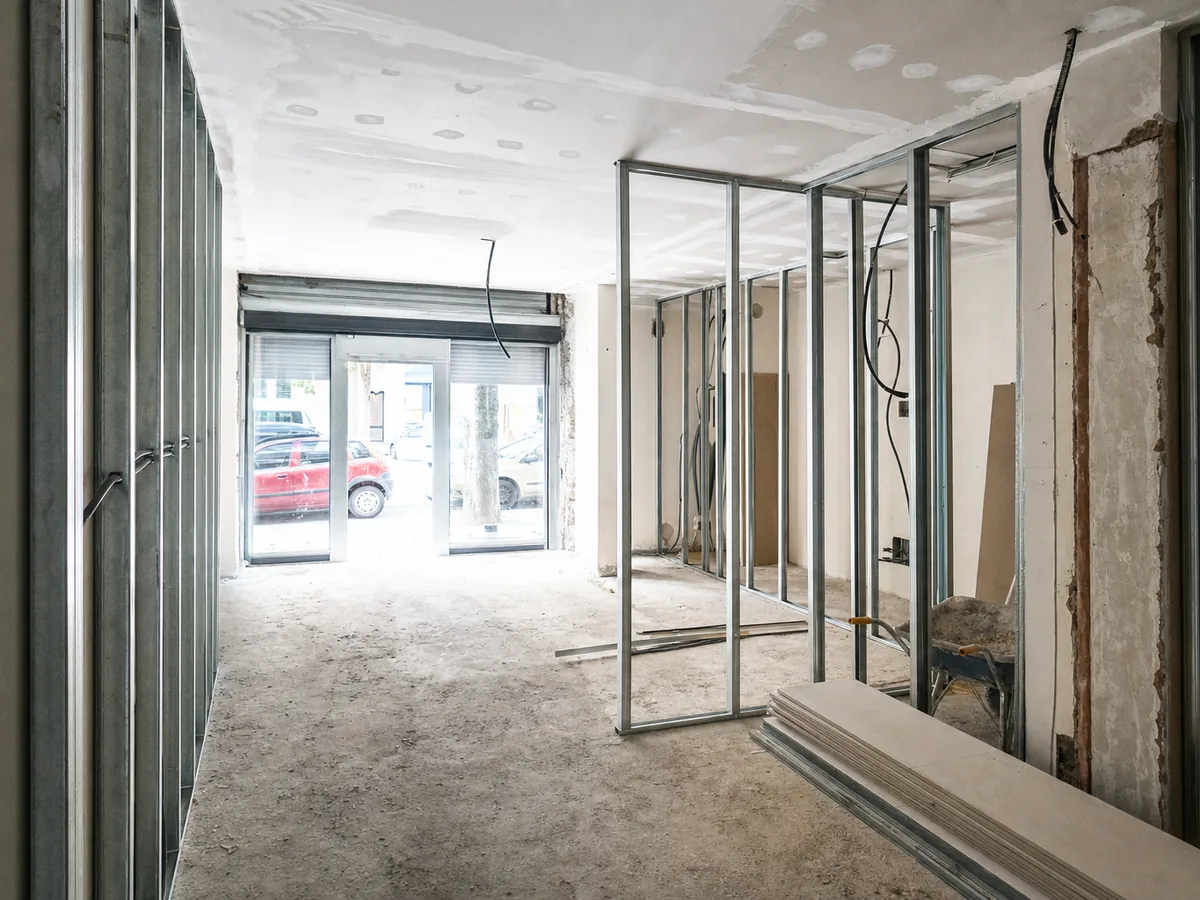
It costs more than renovating an apartment for a simple reason: in a commercial space, nothing is already built. There are no partitions, no utilities, no flooring, no interior woodwork, and often no plumbing in the right place. You're essentially building a home inside a box.
The items that push the quote up the most:
- Sanitation and pumping when the level of the premises is below the network.
- Facade: open or modify openings to provide lighting and ventilation.
- Acoustic and thermal insulation, which is nonexistent in a commercial establishment.
- New electrical installation with a housing certificate, not a business premises certificate.
Even so, the equation usually works out. A closed-down commercial space is bought for significantly less than the price per square metre of a residential property, and that difference is what finances the renovation. To compare with other options, here it is how much it costs to renovate a house in Mallorca in 2026.
Is it profitable to buy a commercial space and convert it into a home?
It becomes worthwhile when the difference between the purchase price of the commercial space and the value of the finished property comfortably exceeds the cost of construction, permits, and fees. In municipalities like Manacor or Inca, where vacant commercial properties have depreciated while residential properties haven't, this margin exists. In areas of Calvià with high residential prices, it's even more pronounced.
What almost never breaks the deal is the price: it's a place that can't meet habitability standards and that nobody checked before buying.
That's why the order matters. First, technical and legal feasibility, then the numbers, and only then the signature. We do this preliminary check before a project even exists, and we also assess whether the building needs structural reinforcement — something common when the change of use involves new loads or opening holes in load-bearing walls.
If the property is also old, it's worth looking at the grants for housing rehabilitation in the Balearic Islands current this year.
Frequently asked questions about converting a commercial space into a home in Mallorca
Can I convert a commercial space into a dwelling in Inca in 2026?
Yes. Inca is one of the Balearic municipalities with more than 20,000 inhabitants that has enabled the change of use from commercial premises to residential housing, and as of August 2026, 20 homes have been obtained through this process in the municipality. The premises must meet habitability requirements—size, ceiling height, ventilation, and natural light—and obtain a major works licence and a change of use permit from the town hall.
How long does it take to change the use of a commercial premises to a residential dwelling in Mallorca?
Between the permit application process and the actual construction work, the typical timeframe is 8 to 14 months. A municipal permit for major construction with a change of use is usually issued in 3-6 months on urban land, and the construction itself takes between 4 and 7 months for a medium-sized building. The self-declaration system already in place in Palma shortens the administrative waiting period.
Do I need permission from the owners' association to convert a commercial space into a dwelling?
It depends on the bylaws. If the community bylaws expressly prohibit a change of use or residential use on the ground floor, they need to be amended, which requires a board resolution. If they are silent on the matter, case law has recognised changes of use without community authorisation, although any work affecting common elements, such as the facade, must be reported.
What happens if the premises do not have enough windows to be considered a dwelling?
Without natural light and ventilation in the habitable rooms, a first occupation licence cannot be obtained, and without it, there is no legal dwelling. The solution involves creating openings in the facade, which requires municipal authorisation and, if the wall is load-bearing, structural reinforcement. If the premises are interior and have neither a facade nor a patio, a viable project is usually not possible.
Is the converted premises suitable for tourist rentals?
Not automatically. Obtaining a first occupation licence converts the premises into a dwelling, but tourist rentals also require a tourist licence and compliance with the specific regulations of the Balearic Islands, which are very restrictive and vary by municipality and area. These are two separate procedures, and the second is considerably more difficult than the first.
When NOT to get involved in a change of use
- When the premises are interior or have little facade. Without natural light there is no first occupation licence, and without it there is no home.
- When the clearance is just right before starting. After installations and raised access flooring, it no longer works.
- When the community bylaws prohibit it and there is no majority to change them.
- When the municipality has not validated the measure and its planning does not allow residential use on that ground floor.
In any of these four cases, the money goes towards projects and fees, only to end up with a no.
Do you have a vacant shop unit? Let's see if it can become a home
Before buying or commissioning a project, it's always inexpensive to check if the premises are suitable. We offer technical visits in Inca, Manacor, Calvià, Llucmajor, and the rest of the island. We take all the necessary measurements and tell you frankly whether the change of use is feasible and how much it would cost.
We are a construction company in Mallorca with our own team since 1967 and more than 1,500 projects completed, and we also handle the home renovations in Mallorca once the premises are your home, call us at +34 625 16 47 18 or write to info@armalutx.com.