Rising damp is water from the ground that climbs up through the pores of a wall, the way coffee climbs up a sugar cube. In old Mallorcan houses, whose stone or marès walls sit on the ground with no barrier at all, it leaves stains and salt deposits on the lower part of the walls, up to roughly a metre, and makes the paint and render blister. It is solved by taking water away from the base of the wall, stopping it from rising and letting the wall breathe with lime mortars. Sealing it with cement or plastic paint makes it worse.
If you have a village house, a traditional Mallorcan farmhouse or a flat in an old building, you probably know the picture: paint coming off in patches at the bottom of the wall, a fine white powder along the skirting and that musty smell that does not go away however much you air the room. It is often painted over, hidden behind a dado or covered with a panel, and a year later it is back. This is rising damp, and it can be fixed when you treat the cause rather than the stain.
What rising damp is
Porous materials such as stone, marès, brick and mortar are full of tiny channels. When the base of a wall is in contact with damp ground, water gets into those channels and rises, just as it climbs a wick. It keeps rising until the evaporation from the surface of the wall matches what comes in from below.
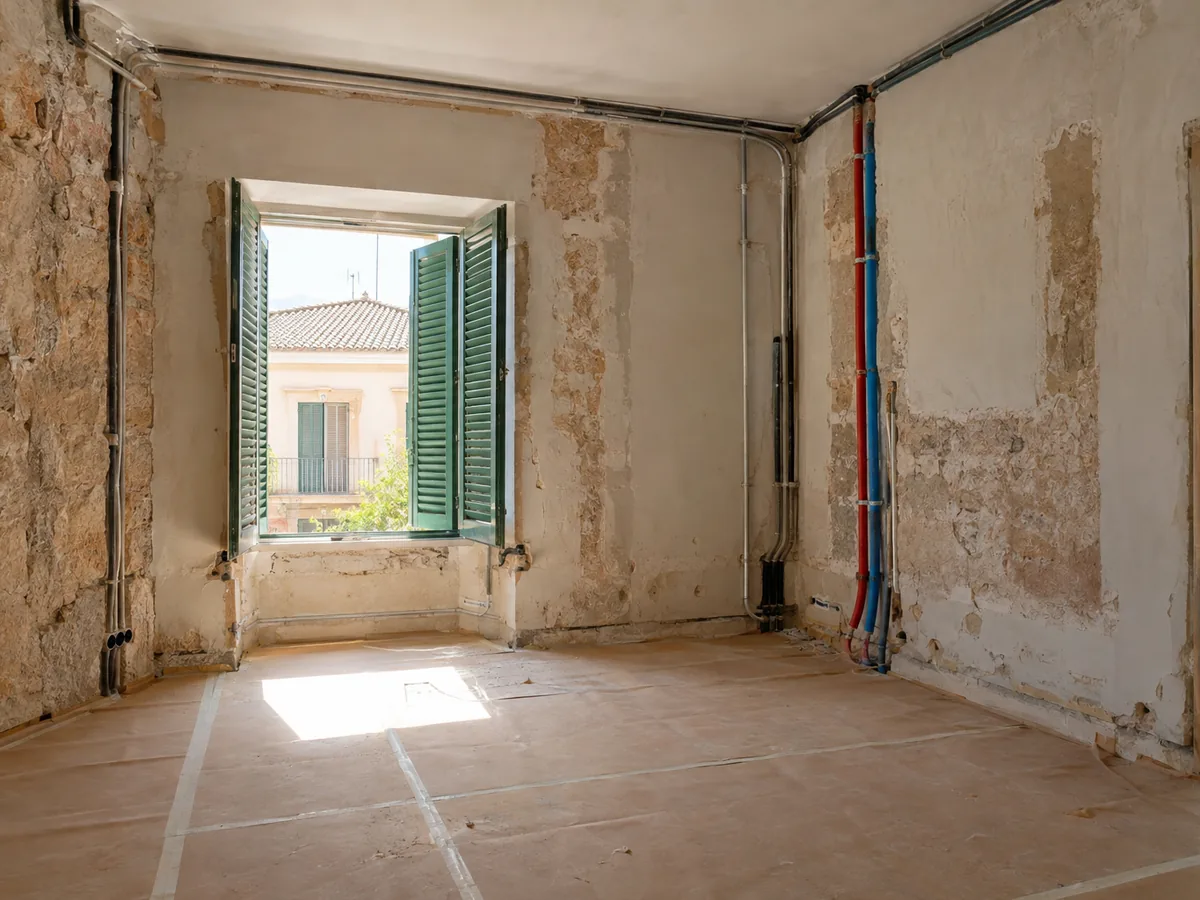
The water carries salts dissolved from the ground. When it evaporates at the surface, the salts stay behind and crystallise: these are the salt deposits, the white marks you see on the lower part of the wall. As they crystallise they take up more space, which is why they push off and break the paint, the plaster and the render.
Why it is so common in old Mallorcan houses
- Marès is very porous. It is a calcareous sandstone, easy to work and very forgiving, but it soaks up water readily.
- The walls stand directly on the ground. Traditional houses do not have the damp-proof membrane that is laid today between the foundations and the wall.
- The ground around them has changed. Tarmacked streets, pavements and concrete patios that sit higher than they used to leave the base of the wall buried and unable to dry out.
- Renovations that have covered it up. Cement render, plastic paint, glued stone skirting or bonded panels stop the wall from evaporating through the face that used to breathe. The water keeps rising and finds a way out higher up.
How to recognise it and tell it apart from other types of damp
Before treating anything you need to be sure it is rising damp. The three most common types of damp in a home look alike, but leave different clues:
- Rising damp: it appears on the lower part of the walls, with a roughly horizontal upper edge at the same height along the whole stretch. It is always there, gets worse after wet seasons and leaves salt deposits and blistered paint.
- Condensation: it shows up in corners, behind furniture, on ceilings and around windows. It gets worse with cold and poor ventilation, and leaves black mould and droplets on the glass.
- Water ingress: it appears where the water gets in, through the roof, the façade, a terrace or a downpipe. It gets worse after rain, and the stains spread and may even drip.
A useful clue: if the stain has a roughly horizontal upper edge at the same height along the whole wall, and it is worse near the floor, it points to rising damp.
How to diagnose it properly
- Measure the moisture in the wall at different heights, from the bottom up, to see how it drops with height.
- Look at the outside: the ground level, the pavement, the patios and whether there are downpipes, gutters or irrigation wetting the base of the wall.
- Make a test opening in the render to see what the wall is made of, whether there is cement and what state the stone and the joints are in.
- Rule out leaks from nearby plumbing, which are sometimes mistaken for rising damp.
Without this step it is easy to spend money on a treatment that does not touch the cause.
Treatments that work
There is no single remedy: what works is combining several measures to suit the house.
Taking water away from the base of the wall
If the ground outside is higher than the floor inside, or rainwater collects against the wall, the first step is to move it away:
- Perimeter drainage: a trench with a drainage pipe and gravel along the wall that collects the water and carries it away.
- Separating the wall from the soil with a ventilated cavity, so that the outer face can dry.
- Correcting falls, downpipes and gutters that discharge water at the foot of the façade.
Stopping the water from rising
The injected chemical damp-proof course is the most common treatment in existing walls. A line of holes is drilled at the base of the wall and a product is injected that stops that band from absorbing water. This creates a barrier similar to the one that was not put in when the house was built.
In walls of irregular stone with wide joints, the product and the method have to be chosen carefully, because the wall is not uniform like a brick one.
Letting the wall breathe
This is the step most often forgotten, and the one that decides whether the repair lasts:
- Hack off cement render and plastic paint in the affected area.
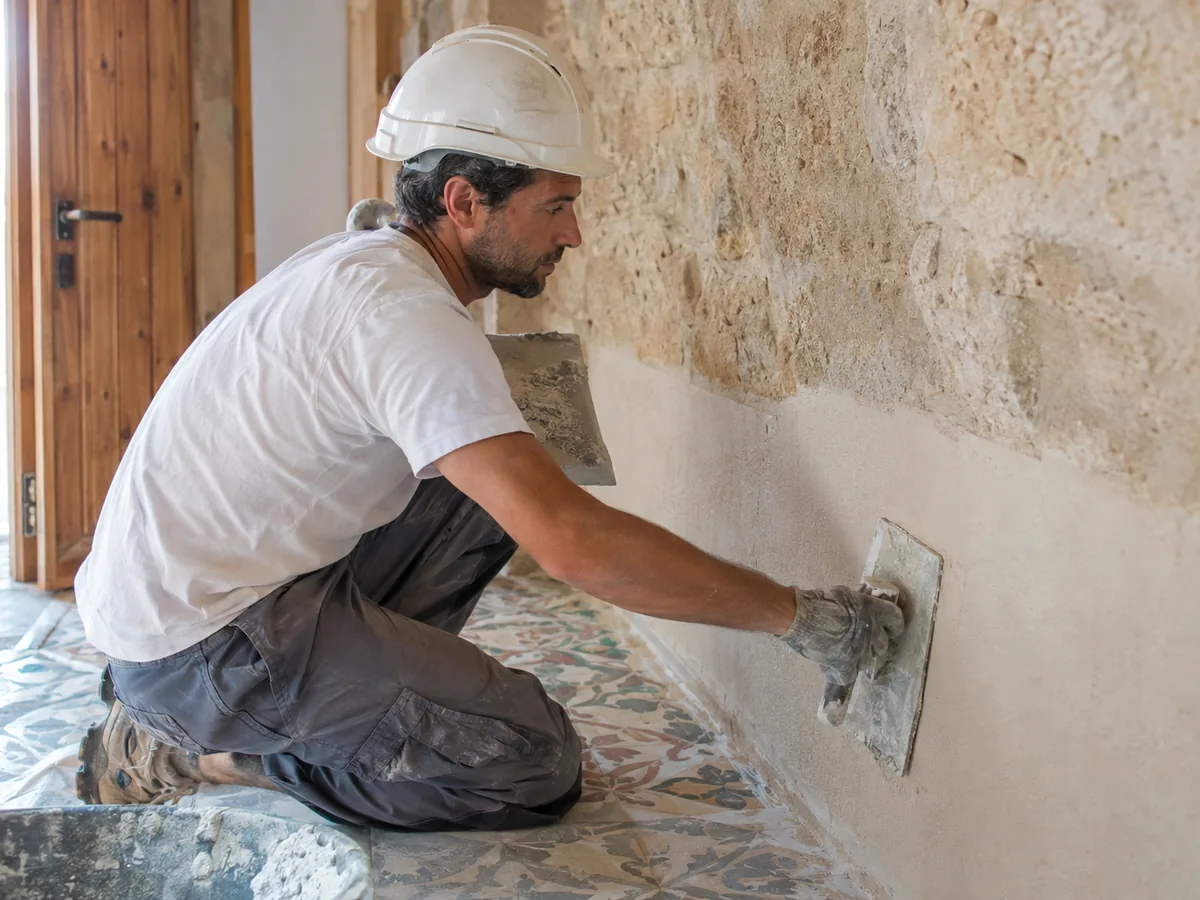
- Finish with lime mortars or with renovation mortars, which let water vapour out and hold the salts without breaking up.
- Allow time. A thick wall that has been wet for decades takes months to dry. Painting or rendering too soon traps the water again.
Floors
In a full ground-floor rehabilitation, replacing a slab laid on the ground with a ventilated floor cuts off another route for damp and greatly improves the result.
What does not work or makes it worse
- Rendering with cement. It is impermeable to vapour: the water cannot escape that way, so it rises higher and the salt deposits appear above the render.
- Painting with plastic or «anti-damp» paint. It hides the stain for a few months, but the water stays inside and the paint ends up flaking off.
- Fixing panels or plasterboard to the wall. They hide the problem and create a void where mould appears.
- Relying on a dehumidifier alone. It helps to dry the air, but it does not stop the water rising from the ground.
Frequently asked questions about rising damp
Can rising damp be cured for good?
Yes, when the cause is tackled: water is kept away from the base of the wall, its rise is stopped and the wall is allowed to breathe. If only the surface is treated, it comes back. The full result shows once the wall has finished drying, which in thick stone or marès walls can take months.
Does anti-damp paint work?
Not on its own. It may improve the look for a while, but it does not stop the water rising. On stone or marès walls, a paint that does not breathe usually makes the problem worse because it traps the moisture.
Can it be treated from inside the house only?
Sometimes, with a chemical barrier and breathable mortars on the inside face. But if the water comes from outside, from higher ground, a pavement or a patio that floods, you also need to work outside or the repair will not last long.
What is the difference between salt deposits and mould?
Salt deposits are white, powdery salt crystals that form on the surface when the water that has risen through the wall evaporates: they are a sign of rising damp. Mould is a black or greenish fungus that appears with condensation in cold, poorly ventilated areas.
Do I need a permit to treat damp in my house?
It depends on the scope. A small interior job may need no procedure at all, and in Palma this work usually goes through prior notification; we explain it in our guide to prior notification of building works in Palma. If the house is listed or on rural land, check first, because the conditions are stricter.
We restore stone and marès walls with traditional craft
At Construcciones Armalutx, a family of builders since 1967, we work with our master stonemasons on old houses all over Mallorca: we diagnose the damp, remove whatever traps the water and give the wall back its lime mortars. You can see how we approach the rehabilitation of dry-stone and marès walls and the rehabilitation of traditional farmhouses and estates, and for an overview of the other types of damp, see how to protect your house in Mallorca from damp. Call us on 625 16 47 18 or write to info@armalutx.com.