A prefabricated house in Mallorca costs between €1,200 and €2,400/m² in 2026, depending on the finishes. Concrete houses start at €1,300/m², with a 10-30% surcharge compared to mainland Spain due to island transport. It requires exactly the same permits as a traditional house: a major works permit, project plans, a geotechnical study, and foundation requirements. And on rural land, it's not a legal shortcut.
Let's start where nobody starts, because it's what causes the most discontent on this island: a prefabricated house is not a house without permits. Every season we see someone who has bought a prefabricated house online, convinced that, since it's not considered "construction," they can simply place it on their property in Sencelles or Campos and start living there. It doesn't work that way. And when the town hall finds out, the problem is no longer about urban planning: it's about money.
That said, industrialised construction has real advantages. Let's look at both sides.
How much does a prefabricated house cost in Mallorca?
Prices will range from €1,200 to €2,400/m² in 2026, depending on the level of finishes. A prefabricated concrete house in Mallorca starts at around €1,300/m², which puts a 100 m² house at approximately €130,000 for the basic structure and finishes. Basic wooden models can be priced below €60,000, but with very different features.
| Type of prefabricated house | Price 2026 (€/m²) | 100 m² house |
|---|---|---|
| Modular wood, basic range | 500 – 900 €/m² | €50,000 – €90,000 |
| Standard prefabricated | 1,200 – 1,600 €/m² | €120,000 – €160,000 |
| Prefabricated concrete | from €1,300/m² | from €130,000 |
| Designer industrialised build | 1,600 – 2,400 €/m² | €160,000 – €240,000 |
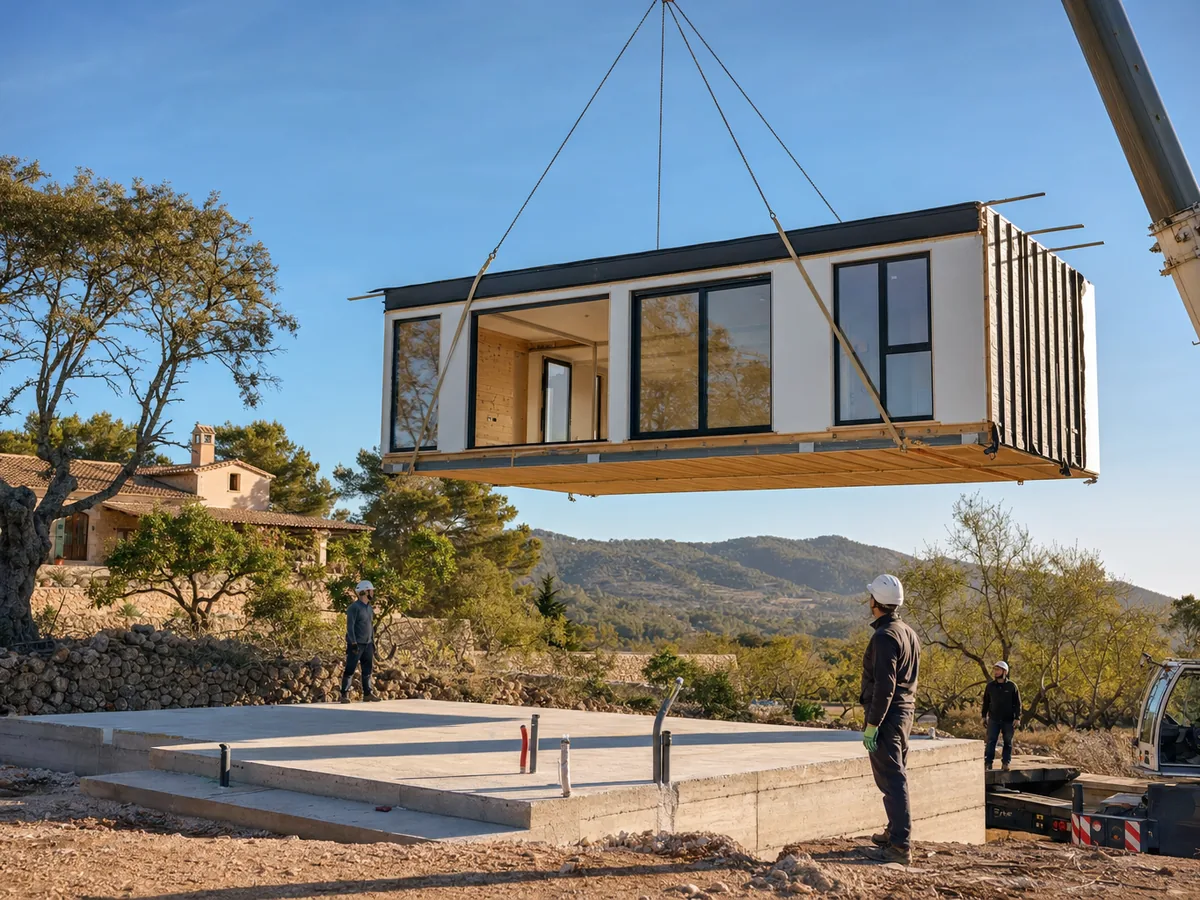
An important note about these prices: they are almost always advertised without foundations, without transport to the island, without a crane, without utility connections and without a permit. And those items, in Mallorca, are not minor.
What costs get added to the catalogue price?
The ones that turn a €130,000 quote into a €190,000 one. On top of the price of the module you have to add the foundations, sea freight, lifting equipment, water, electricity and drainage connections, the municipal permit and professional fees.
- Foundation and earthworks: from €8,000 on a flat plot, considerably more on a slope.
- Island transport and crane: the 10-30% extra compared with the mainland comes mainly from here.
- Connections and drainage: on rural land, with no mains network, you have to sort out a private treatment plant and a water supply.
- Project, construction management and geotechnical study: mandatory, as in any new construction.
- Construction fees and taxes: between 3% and 6% of the construction cost.
- Site works and access: fencing, access road, crane platform.
Does a prefabricated house in Mallorca require a building permit?
Yes, exactly the same as a traditionally built house: major works permit, with a technical project approved in accordance with the Technical Building Code, technical management and geotechnical study. The construction system does not change the urban planning regulations; what matters is that a building intended for housing is being created.
This is the most expensive myth going about modular construction. The idea that "if it has no foundations it is not building work" has no legal backing whatsoever: case law treats as a building any installation intended to stay put, even a demountable one. And the town council does not judge whether the module can be taken away, but whether it is there to stay.
Is it possible to put a prefabricated house on rural land in Mallorca?
Only under the same conditions in which a traditional house would be authorised, which in the Balearics are fairly restrictive: a plot with the minimum area set by the planning rules, compliance with the rural land regime and a permit beforehand. If your plot will not take a house built traditionally, it will not take a prefabricated one either.
In Mallorca this is especially relevant because rural land occupies most of the territory and its regime is regulated by the Government of the Balearic Islands along with each municipality's planning. We discuss this in detail in our article on whether whether it is possible to build on rural land in Mallorca. Placing a module without a license in protected rural land can result in urban planning disciplinary proceedings and a demolition order, with the cost borne entirely by the owner.
How long does it take for a modular home to be ready in Mallorca?
Manufacture and assembly are done in 60 to 90 days once the permit is granted. The problem is that the permit takes between 2 and 5 months, and before that the design has to be drawn up and the geotechnical survey carried out. The realistic timescale from start to finish is 8 to 12 months, not three.
Even so, there's an undeniable advantage: the on-site construction phase is very short and highly predictable, because it's manufactured in a climate-controlled workshop. On an island where summer slows down construction and autumn brings storms, that's worth money.
What is the difference between a prefabricated, modular, and industrialized house?
These are three different levels of the same concept, and the confusion between them explains many disappointments.
| Item | What it is | Level of customisation |
|---|---|---|
| Prefabricated | Catalogue home with mass-produced elements | Low |
| Modular | Complete volumes manufactured in the workshop and assembled on site | Medium |
| Industrialised | Bespoke design with much of the building produced in the workshop | High |
High-end industrialised construction comes very close to the result of traditional building in quality and customisation, and there the future does lie. What is sold online at €500/m² is something else entirely.
Is it cheaper than a traditionally built house?
On the module, yes; on the finished project, not so much. Once you add foundations, island transport, connections, permits and site works, the difference from a well-contracted traditional job narrows a great deal, and at the high end it practically disappears.
Our experience after almost sixty years of building here: prefabricated clearly wins on timescale and on price predictability; traditional building wins on adapting to the ground, on durability against the salt-laden climate and on resale value. If you want the cost comparison for conventional building on the island, we have it in how much it costs to build a villa in Mallorca.
What problems do prefabricated houses present in the climate of Mallorca?
The three usual ones are corrosion of metal fixings from salt, thermal behaviour in summer and maintenance of the external cladding. None is insurmountable, but modules designed for a continental climate are not always ready for the coastal Mediterranean.
Salt is the great enemy. On the seafront, a fixing or bolt without proper protection degrades far faster than the manufacturer's data sheet suggests. If you are buying modular for a coastal plot, insist on a stainless steel specification suited to the marine environment and check the real guarantee against corrosion.
When a prefabricated house is NOT the right choice in Mallorca
- When the plot has a steep slope or difficult access. Transport and crane costs can increase the price more than you save, and on many rural roads in the Serra, the truck simply cannot get in.
- When you're looking for a highly personalized home. If you are going to change half the catalogue, you are paying the premium for industrialisation without getting its advantage.
- When the land is not suitable for housing. No construction solution can turn a non-buildable plot into a buildable one.
Frequently asked questions about prefabricated houses in Mallorca
Does a prefabricated house need a foundation in Mallorca?
Yes, always. Every prefabricated home rests on a foundation sized according to the geotechnical study of the plot, whether it's a slab, continuous footings, or piles. The idea that the module "rests on the ground" is false for any dwelling intended for permanent residential use, and without a planned foundation, a building permit cannot be obtained.
Can you mortgage a prefabricated house in Mallorca?
Yes, provided it's built with a permit, declared as new construction in the deed, and registered in the Land Registry. Banks readily finance prefabricated homes with concrete or steel frames. Lightweight wood homes or those without a registered title to the land face significantly more difficulties in appraisal and financing.
How long does a prefabricated house last?
Well-built concrete or metal-framed houses have a lifespan comparable to traditional construction, exceeding 50 years. Lightweight wooden houses are highly dependent on maintenance: in Mallorca's saline environment, they require periodic treatment of the building envelope every three to five years to maintain their performance.
Does a prefabricated house pay the same taxes?
Yes. It pays the Tax on Construction, Installations and Works when the permit is applied for, it is registered with the Spanish Cadastre electronic office like any other building and it generates council tax on the same terms. There is no tax advantage from the building system used.
Can I install a prefabricated house on a rural property that already has a house?
Only if the planning rules allow a second building on that plot, which is rare in Mallorca. The usual situation is that the plot has used up its buildable allowance with the existing house. In some cases the current house can be extended within the permitted limits, but that is an extension, not a separate dwelling.
Before you buy the module, let's look at your plot
If you're considering a prefabricated home in Mallorca, the correct order is the reverse of what's usually done: first, check what your plot allows, then choose a construction system. At Construcciones Armalutx, we've been building homes all over the island since 1967, with over 1,500 projects completed, and we'll tell you frankly whether your land can accommodate what you have in mind.
Call us at 625 16 47 18 or write to us at info@armalutx.com. We are a construction company in Mallorca with our own crews, and we also carry out the full turnkey new build , from the plot to the keys.