A geotechnical survey is compulsory for any new building under Basic Document SE-C of the Spanish Technical Building Code, and practically every town council in Mallorca requires it in order to grant the building permit. In 2026 it costs between €400 and €3,000 for a detached house, with the average around €1,000-€1,900 plus VAT. It is commissioned before the detailed design, not after.
There is a scene that repeats itself every building season in Mallorca. The developer has the plot, has the architect and is in a hurry, and someone suggests saving on the geotechnical survey "because the neighbour built without one". Two months later a cavity turns up in the limestone three metres down and the planned foundations are no longer any use. That saving of a thousand euros ends up costing thirty thousand.
The Mallorcan subsoil is particularly treacherous, and now you'll see why.
What is a geotechnical study and what is it used for?
This is the technical report that establishes what the ground beneath your plot is like and what foundation the building needs. It analyses the composition of the soil, its bearing capacity, the depth of firm ground, the presence of water and how chemically aggressive the ground is towards concrete, and it ends with a specific recommendation on the type and depth of foundation.
Without it, the architect sizes the foundation by analogy or by conservative assumptions. This means one of two things: either it increases the cost of the project by oversizing for safety, or it falls short. Neither is good.
When is a geotechnical study mandatory in Mallorca?
It is mandatory in all new buildings and in any intervention that modifies the foundation or increases the loads transmitted to the ground, according to Basic Document SE-C of Technical Building Code. On top of that, the town councils of Mallorca require it as part of the documentation for granting the major works permit.
Specific cases where you will definitely need it:
- New construction of single-family or multi-family housing, without exception.
- Height expansion of an existing building, because the loads on the current foundation change.
- Basement or semi-basement excavation, very common in the hillside villas of Andratx or Calvià.
- Large volume in-ground swimming pools near the building or a retaining wall.
- Comprehensive rehabilitation with underpinning, when there is differential settlement. We explain this in detail in our article on foundation underpinning.
- Construction on rural land with access to previously undeveloped land.
How much does a geotechnical study cost in Mallorca in 2026?
Between €400 and €3,000 for a single-family home, depending on the number of boreholes and the depth of the investigation. The typical cost for a standard plot on the island is between €1,000 and €1,900, plus 21% VAT. For larger plots or those with complex terrain, the price increases.
| Type of work | Cost 2026 (excluding VAT) |
|---|---|
| Basic geotechnical report, single-family home | €400 – €900 |
| Full survey with boreholes, detached house | €1,000 – €1,900 |
| Complex land or large plot | €2,000 – €3,000 |
| Multi-family building | from €3,000 |
| Additional laboratory tests | €150 – €500 |
To put it in perspective: on a 200 m² house built in Mallorca, the geotechnical survey comes to less than 0.5% of the total cost of the works. It is by some distance the cheapest insurance you will take out on the whole project.
What does a geotechnical study include and how is it done?
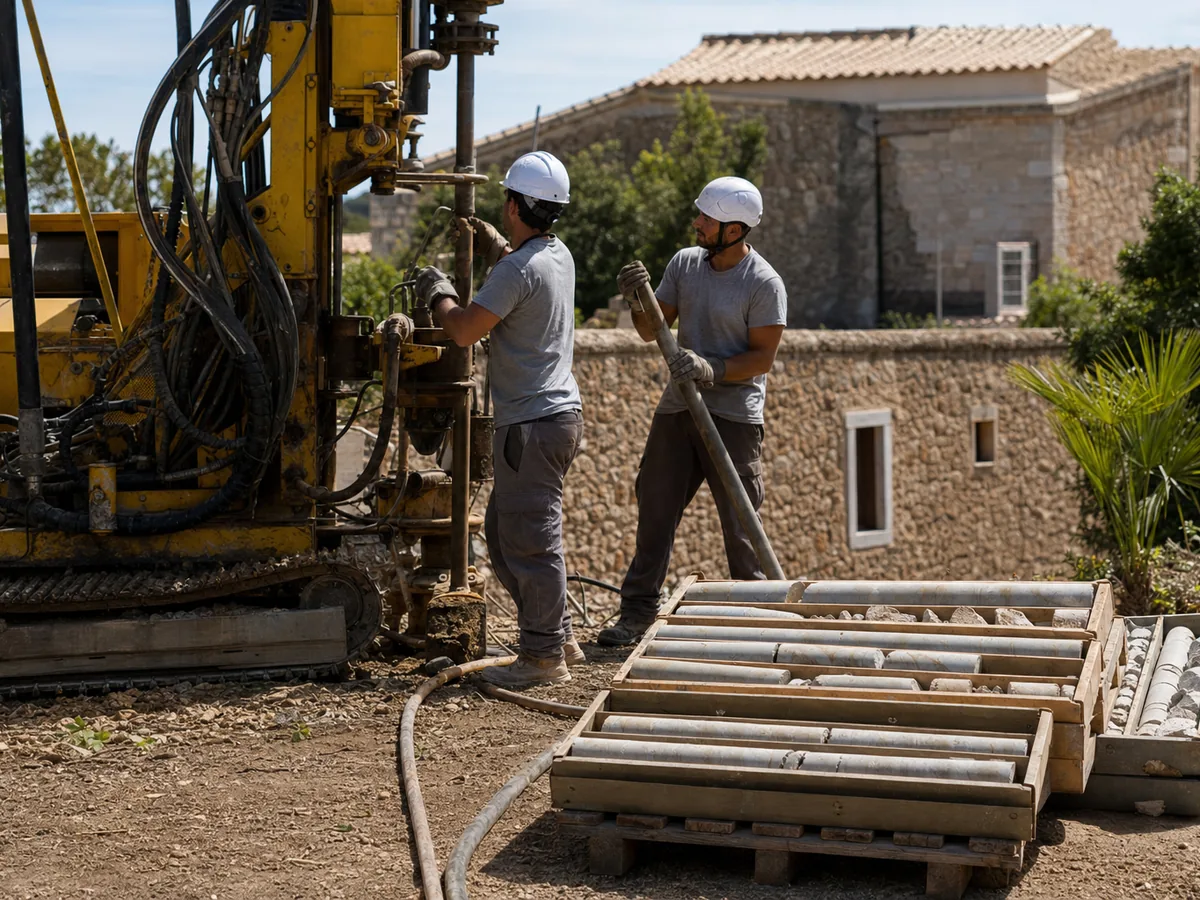
It includes fieldwork, laboratory tests, and a report with foundation recommendations signed by a qualified technician. The complete process follows these steps:
- Prior recognition of the plot and consultation of the geological cartography published by Geological and Mining Institute of Spain.
- Sinking boreholes and trial pits, normally between three and five points depending on the surface.
- Dynamic penetration tests to measure the resistance of the ground at depth.
- Sample collection and laboratory analysis of particle size, moisture content and chemical aggressiveness.
- Groundwater level detection, key in coastal plots.
- Report writing with the allowable stress and the recommended type of foundation.
The fieldwork can be completed in a single day on most plots. What takes time is the laboratory work and the writing up of the reports.
What terrain problems occur most frequently in Mallorca?
The four classics on the island are karst cavities in limestone, uncompacted made ground, expansive clays and a high water table in coastal areas. Each one calls for a different foundation solution.
- Karst. Much of Mallorca's bedrock is limestone, and limestone dissolves in water. The result is cavities, sinkholes, and clay fillings within the rock. A foundation resting on the roof of a cavity is a ticking time bomb.
- Made ground. In urban areas and on plots where there was a building before, uncompacted rubble fill turns up that can run to several metres.
- Expansive clays. They change volume with humidity: they swell in winter and shrink in summer. They are the cause of most differential settlement cracks in homes in the Pla de Mallorca region.
- Water table and saline water. On the seafront and in low-lying areas, water governs the excavation and calls for sulphate-resisting concrete.
This is exactly why you cannot extrapolate from the neighbour's geotechnical survey. Two adjoining plots on the same lane can behave in radically different ways.
What happens if you build without a geotechnical study in Mallorca?
The town council can refuse the permit, the architect cannot take on the foundation calculations and, if structural damage appears later, responsibility falls directly on the owner. On top of that, the ten-year structural insurers require it in order to cover the works, as laid down by the Building Regulations Act.
That last point is the one most people are unaware of. The ten-year structural damage insurance policy relies on the technical oversight of the project, and without a geotechnical inspection, that inspection cannot validate the foundation. Building without one is not only risky: it also leaves you without coverage.
When should the geotechnical study be commissioned?
Before drafting the construction project and, if possible, before purchasing the plot. Commissioning it late forces you to recalculate and modify the project, with the associated costs and delays.
Our advice, after half a century of building on the island: if you're considering buying a plot of land with limited building rights or a significant slope, make a geotechnical survey a condition of the purchase. A thousand euros well spent can save you from buying a plot whose foundation costs fifty thousand euros more than anticipated. We detail the complete steps in our guide on building permits in Mallorca.
When is it NOT necessary to commission a geotechnical study
- On interior renovations that do not touch the foundations or increase the loads on the ground.
- On minor works: replacing floors, joinery, services or finishes.
- In light ancillary structures of little consequence, such as a demountable porch or a garden shed, provided the town council does not expressly require it.
Outside these cases, and as soon as foundations are involved, the answer is always yes.
Frequently asked questions about geotechnical studies in Mallorca
How long does it take to receive a geotechnical study in Mallorca?
Between 10 and 20 days from the date of contract, including fieldwork, laboratory tests, and report writing. During peak construction season—spring and early autumn—geotechnical companies on the island are overwhelmed, and the timeframe can extend to a month, so it's advisable to book well in advance.
Is the geotechnical study of the adjacent plot of land useful?
No. The CTE requires a specific survey for each plot, and in Mallorca that requirement has a real basis: karst ground varies abruptly over very short distances. Two adjoining plots can have sound rock at one metre on one and fill with cavities at four metres on the other.
Who signs the geotechnical study?
It is signed by a qualified technician with a degree in geology, geological engineering, civil engineering, or a related field, and issued by a company with an accredited laboratory. The project architect does not draft it; they receive it, interpret it, and design the foundation according to its conclusions.
Does the geotechnical study cover the presence of archaeological remains?
No, they are different things. The geotechnical survey analyses the mechanical behaviour of the ground, not its heritage value. In Mallorcan municipalities with listed archaeological sites, archaeological monitoring during the excavation may also be required, which is processed separately through the Consell de Mallorca.
Can an old geotechnical study of the same plot be reused?
Yes, if it is less than ten years old, the plot has not had any earthworks and the planned building is equivalent in loads to the one that was studied. If the new building is larger, has a basement or moves position within the plot, it has to be updated or extended with additional boreholes.
We'll take you from the ground to the keys
If you're considering building in Mallorca, a geotechnical study is the first serious step in the project, and it's best to have it done with the right support. At Construcciones Armalutx, we've been building structures all over the island since 1967, with over 1,500 projects completed, and we coordinate the geotechnical study, the project design, and the permitting process all within the same service construction company for new builds in Mallorca.
Call us at 625 16 47 18 or email us at info@armalutx.com and we'll review your plot of land before you invest in the project. We are a construction company in Mallorca with our own crews and half a century of completed work.