Damaged wooden beams are detected by four signs: fine sawdust under the ceiling, a hollow sound when tapped, visible sagging or bowing, and persistent damp patches at the supports. A reliable diagnosis is made with a resistograph, which measures the actual internal resistance of the wood on site. Reinforcing costs between €30 and €150/m², and replacing with metal joists costs considerably more.
In a Mallorcan village house, the timber-beam ceiling is the finest thing it has and, at the same time, what degrades most silently. We have been opening up ceilings in Inca, Sineu, Pollença and Palma since 1967, and one pattern keeps repeating: by the time the owner calls us, the beam has been damaged for years. Timber does not warn you the way concrete does. It does not crack the plaster or flake off. It simply hollows out from the inside.
The good news is that almost all the signs can be seen from the ground if you know what to look for.
What signs indicate that a wooden beam is damaged?
The most reliable signs are fine sawdust accumulated under the beam, a hollow sound when tapped, visible warping or sagging of the ceiling, and persistent dampness in the area where it rests on the wall. If two or more of these appear simultaneously, a professional inspection should be carried out without delay.
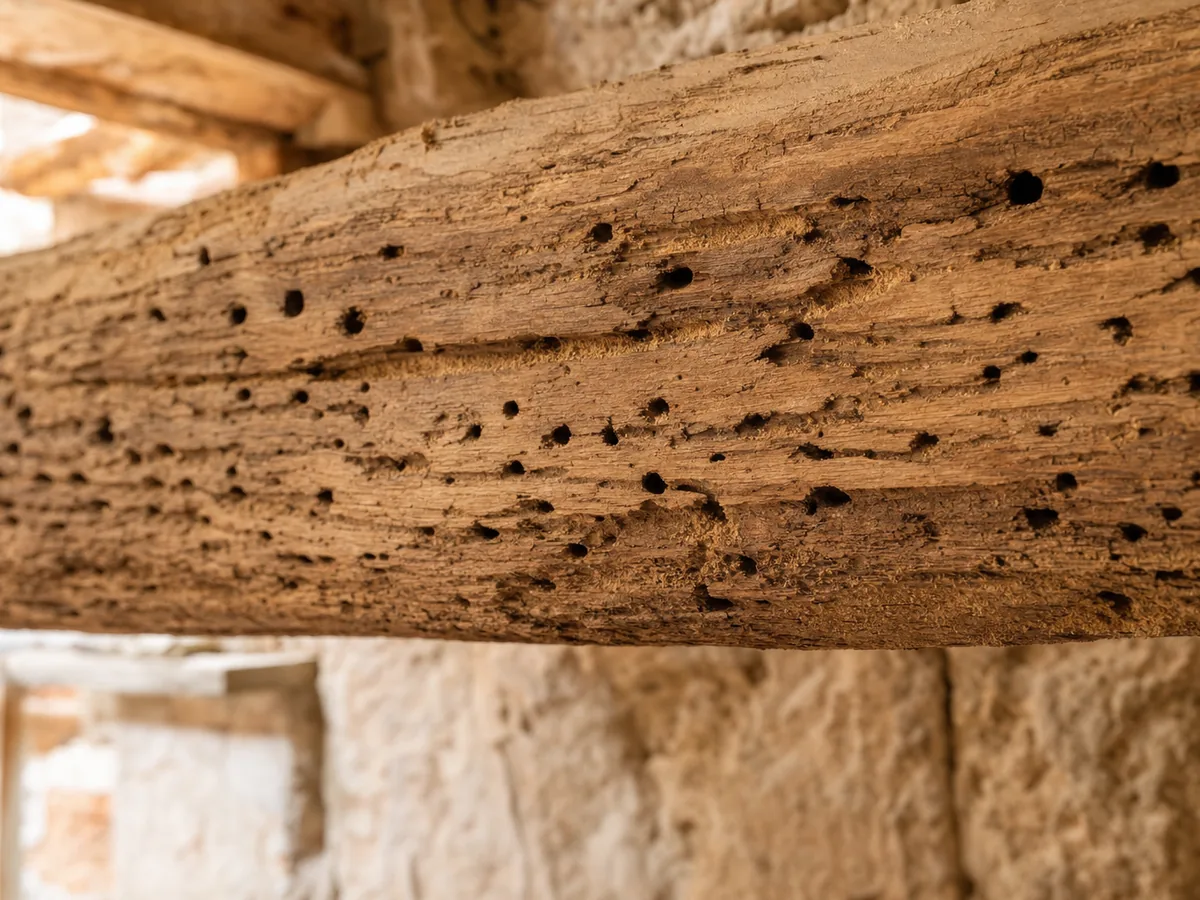
- Sawdust or fine powder on the floor, on furniture, or on the windowsill under the beam. It's living activity, not an ancient remnant.
- Small, well-defined holes on the surface, grouped or in a line.
- Hollow sound when tapped with your knuckles, compared with the solid sound of a healthy beam.
- Excessive deflection: the ceiling sags and a straightedge held against it reveals the curvature.
- New longitudinal cracks that were not there last year.
- Dark stains and soft wood on the support, where the beam enters the wall. This is the area that rots first.
- Doors that stop closing or floors that creak differently on the upper floor.
We always discover that last point by chance. The client has been forcing a door for months and hasn't connected the problem to the floor slab above.
How to distinguish woodworm damage from a termite infestation?
Woodworm leaves visible holes and sawdust on the exterior; termites work from the inside and leave no external sign until the beam is already hollowed out. That's why termites are much more dangerous: structural damage appears before any symptoms.
| Indication | Woodworm | Termites |
|---|---|---|
| External holes | Yes, defined and grouped | Rarely visible |
| Sawdust | Abundant and fine | Virtually absent |
| Galleries | Superficial | Internal, they follow the grain |
| Detection | Visual | Probing, awl or resistograph |
| Damage speed | Slow | Fast and quiet |
| Additional trail | — | Earth tunnels in walls |
A handy tip: stick an awl or a thin screwdriver into the suspected area. If it goes in with little resistance, the wood has lost strength, whether or not there are visible holes. If you'd like to learn more about this treatment, we cover it in this article on woodworm and how to save your historic home.
How do you check the actual condition of a wooden beam?
With a resistograph: a device that drives a very fine needle into the wood and measures the resistance it meets along the way. The result is immediate and on site, and it tells you how much sound section is left without destroying the beam or lifting the floor above.
A complete diagnosis of a timber floor structure includes:
- Visual inspection of all beams and their wall supports.
- Manual probing with an awl at the suspect points.
- Measuring the moisture content of wood.
- Testing with a resistograph on the critical beams.
- Calculation of current loads versus residual bearing capacity, according to Basic Document SE-M of Technical Building Code.
- Report with classification of each beam: sound, reinforceable or to be replaced.
Without this step, any quote is guesswork. And with timber the eye deceives: we have seen beams that look immaculate with 60% of their cross-section eaten away from the inside.
When is a damaged wooden beam dangerous?
It is dangerous when it has lost structural integrity in the support area, when the deflection exceeds the permissible limit, or when the wood crumbles under pressure. In these cases, the risk of collapse is real, and the structure must be shored up before any other decisions are made.
There is one particular case we see a lot in Mallorca and always treat as urgent: a beam that looks sound in the middle but is rotten where it goes into the outside wall, from rising damp or a leak in the roof. It is not the beam that fails there: it is the bearing. And a bearing that gives way gives no warning.
Can a wooden beam be repaired or does it need to be replaced?
It can be repaired if a sufficiently sound section remains; it is replaced when the damage exceeds approximately one-third of the section or affects the supports in a widespread manner. The decision is based on the report, not on the owner's aesthetic preference.
The usual solutions, from least to most intervention:
- Consolidation with epoxy resins, for superficial and localized damage.
- New wood graft at the rotten end, preserving the original beam in view.
- Reinforcement with metal profiles attached or with carbon fibre, when capacity needs to be increased without adding weight.
- Replacement with metal or laminated wood joists, with the floor slab shored up beforehand.
- Comprehensive reinforcement of the slab with mecanoviga type systems when the damage is widespread.
In listed properties in the centre of Palma or in the villages of the Raiguer, the heritage regulations run by the Consell de Mallorca usually require the exposed beams to be kept. There, grafting and consolidation stop being an aesthetic choice and become the only legal route.
How much does it cost to repair or replace wooden beams in Mallorca?
Reinforcing a wooden floor costs between €30 and €150/m² depending on the technique, and the preliminary assessment with a resistograph costs around €400-€900. Complete replacement of beams is significantly more expensive because it requires shoring, demolition of the upper flooring, and replacement of finishes.
| Work | Estimated cost 2026 |
|---|---|
| Structural diagnosis with testing | €400 – €900 |
| Consolidation with epoxy resin | 60 – 120 €/ml |
| Beam head graft | 250 – 500 € per beam |
| Reinforcement with metal profile | 30 – 150 €/m² |
| Mecanoviga-type reinforcement | 180 – 260 €/ml |
| Anti-woodworm treatment of the slab | 15 – 30 €/m² |
If you want a complete breakdown of the most common solution for generally affected slabs, you can find it in our article on how much does it cost to install mecanovigas in Mallorca.
Why do wooden beams in Mallorcan houses get so damaged?
Because of the combination of high ambient humidity, salt in coastal areas and marés walls that draw water up by capillary action. Timber in Mallorca works in more demanding conditions than inland on the mainland, and wood-boring insects find a favourable climate here for almost the whole year.
Add to that a peculiar local construction feature: in many old houses, the beams rest directly on the stone wall, without any damp-proof course. This direct contact, on a wall that absorbs water from the ground, is the source of most of the rotten beam ends we repair. It's not a defect in the wood; it's a moisture bridge that no one broke 150 years ago.
When it is NOT advisable to preserve the original wooden beams
- When the termite infestation is active and widespread. Keeping an infested beam is simply transferring the problem to the rest of the floor slab.
- When you're going to change the usage and increase the loads. A wooden floor slab sized for a bedroom in 1900 cannot support a library, a freestanding bathtub, or a walkable roof.
- When the cost of maintenance exceeds the cost of replacement and the building is not listed. Sometimes an attachment to the exposed beam works out far more expensive than a well-executed new floor structure.
Frequently asked questions about damaged wooden beams
How can I tell if the woodworm in my wooden beams is active?
The definitive sign is fresh sawdust: clean the area under the beam and check if the dust reappears in the following weeks. If it does, there is active infestation. Holes alone don't confirm this, as they could be from an old infestation that has already died down, and in that case, the treatment changes completely.
How much does a structural report for a wooden floor slab cost in Mallorca?
Between €400 and €900, depending on the number of beams and whether resistograph testing or laboratory analysis is included. For large houses or entire buildings, the price increases, but it still represents a minimal fraction of the repair cost. Many construction companies, including ours, deduct this cost from the estimate if the project is awarded to us.
Can wooden beams be reinforced without lifting the floor above?
Yes, in many cases. Reinforcement with fixed metal profiles, consolidation with resins or mecanoviga-type systems are carried out from below, without touching the floor of the storey above. Only when the whole beam has to be replaced or the infill between joists rebuilt does working from above become unavoidable.
Is it compulsory to check the timber floor structure before buying an old house in Mallorca?
It's not legally required, but it's the most cost-effective inspection you can do before signing. A report costing a few hundred euros can reveal structural repairs worth tens of thousands, and that information is perfectly legitimate leverage in negotiating the purchase price.
Does home insurance cover the replacement of beams damaged by termites?
Usually not. Home insurance policies exclude damage from pests and from the progressive degradation of materials, which is how an attack by wood-boring insects is classified under the warranty regime of the Building Regulations Act. Damage resulting from an accidental water leak that has caused rot is usually covered, so it is advisable to check the terms and conditions and the actual origin of the damage.
Request an inspection of your floor slab before it becomes urgent
If you've seen sawdust, noticed a sagging ceiling, or recently bought an older home with exposed beams, a timely inspection can completely change the cost of the repair. At Construcciones Armalutx, we've been diagnosing and repairing floor slabs across the island since 1967, and we specialize in structural reinforcements in Mallorca on wood, concrete and steel.
Call us at 625 16 47 18 or write to us at info@armalutx.com and we'll review it. We are a construction company in Inca with over 50 years working throughout Mallorca.