Roof renovation in Mallorca costs between €50 and €100/m² for partial renovation and between €34 and €150/m² for complete replacement, with a market average of €92/m². A 130 m² pitched roof with reclaimed Arabic tiles will cost between €14,500 and €26,000 in 2026. Improvements to insulation may be eligible for renovation grants covering between 40% and 80% of the cost.
The roof is the part of the house that takes the most punishment in Mallorca and the least attention. Direct sun ten months a year, sea salt on the coast, torrential autumn rains that dump in two hours what falls in other areas in a month, and the tramontana wind pushing the tiles away. When the first stain appears on the bedroom ceiling, the problem isn't new: it's been brewing up there for years.
How much does it cost to renovate a roof in Mallorca in 2026?
Partial renovation costs between €50 and €100/m², and complete roof replacement ranges from €34 to €150/m² depending on the material and complexity, with the national average at €92/m². For a 130 m² single-family home with a pitched roof and curved ceramic tiles, the realistic price range in 2026 is €14,500 to €26,000, including VAT.
| Work | Price 2026 |
|---|---|
| Re-roofing (removing and replacing tiles) | 20 – 40 €/m² |
| Spot repair of a leak | from €300 |
| Partial roof rehabilitation | 50 – 100 €/m² |
| Complete replacement with insulation | 90 – 150 €/m² |
| Complete roof of a 130 m² house | €14,500 – €26,000 |
| Removal of asbestos cement | 8 – 25 €/m² additional |
We provide the figures because no one else on the island does. Most roofing websites in Mallorca end with "free quote" and force you to call to find out if your project will cost five thousand or twenty-five thousand euros.
What does a complete roof renovation include?
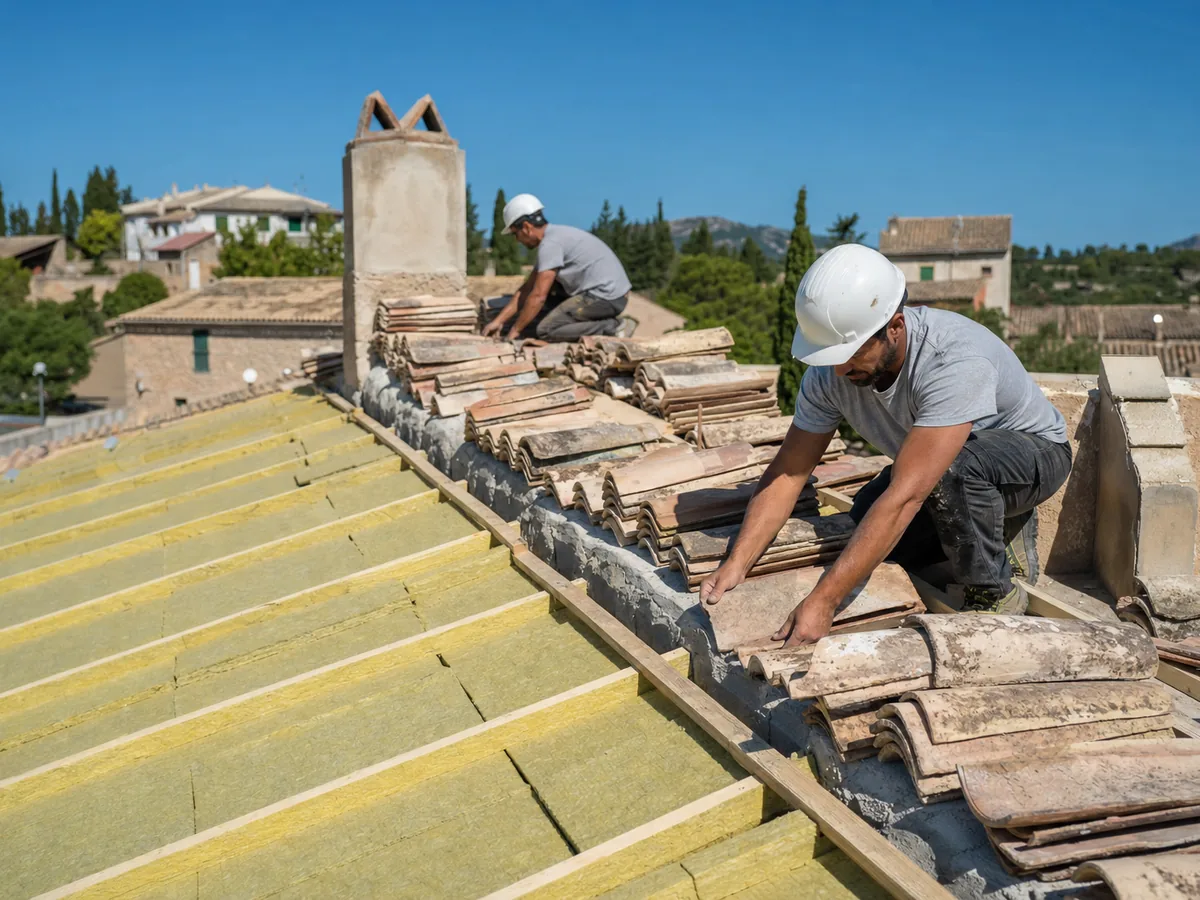
It includes the dismantling of the existing roof, the inspection and reinforcement of the structural support, the formation of slopes, waterproofing, thermal insulation and the placement of the tile, as well as finishing touches, gutters and final cleaning.
- Dismantling and stockpiling of recoverable roof tiles, highly valued in traditional roofs.
- Inspection of the floor slab or wooden structure, with reinforcement or replacement if necessary.
- Waterproofing membrane and vapour barrier correctly lapped, as required by Basic Document HS-1 of the Technical Building Code.
- Thermal insulation under the roof tiles, the item that makes the biggest difference in the heating and cooling bill.
- Installation of Arabic, mixed or flat tiles, according to typology and municipal regulations.
- Ridges, valleys, chimney connections and new gutters.
- Removal of waste and disposal at an authorised facility.
One thing separates a job well done from a botched one: the junctions. Tiles rarely fail in the middle of the slope; they fail in the valley, where the roof meets the chimney and at the abutment against the neighbour's wall. That is where the water gets in.
When is it time to re-roof and when does the entire roof need to be renovated?
A roof is re-tiled when the structure and the waterproofing are sound and the problem is broken or slipped tiles. It is fully refurbished when there are widespread leaks, when the structure has given way, or when the roof has no modern insulation or waterproofing, which is the norm in any home built before the 1980s.
Signs that indicate complete rehabilitation and not just a temporary fix:
- Damp patches in various spots on the ceiling of the top floor.
- Roof tiles are repeatedly displaced after each storm.
- Wooden beams with rot or sagging visible from the inside.
- Total lack of insulation: the top floor is an oven in August.
- Overflowing gutters and water running down the facade.
- More than 50 years without any intervention on the roof.
If your roof rests on wooden beams, before making a decision it's advisable to read our guide on how to tell whether the wooden beams are damaged: it completely governs the quote.
What types of roofing are made in Mallorca?
Four types of roof coexist on the island, and each has its own logic when it comes to renovation. The choice is not only aesthetic: in many municipalities it is governed by the planning regulations and by the heritage listing.
| Type of roof | Where it is common | Renovation note |
|---|---|---|
| Traditional Arabic tile | Village houses and country estates | The old tile is salvaged and relaid on the exposed face |
| Mixed or flat tile | Housing from the 70s-90s | Easy replacement, good price-performance ratio |
| Walkable flat roof | Palma and urban buildings | It hinges on the waterproofing, not on the tile |
| Fibre cement (uralite) | Annexes, garages, warehouses | Must be removed by a company on the RERA asbestos register |
That last case deserves attention. If your roof is made of asbestos cement and was installed before 2002, it contains asbestos, and its removal can only be carried out by a company registered in the Register of Companies with Asbestos Risk, with a work plan approved in accordance with the Royal Decree 396/2006. It is not a recommendation: it is a legal obligation, and the penalties for non-compliance are severe.
Do you need a permit to renovate a roof in Mallorca?
Yes, except for very minor one-off repairs. If the structure is touched, the pitch is changed or the whole roof is replaced, a major works permit with a design is needed. In historic centres and listed buildings a heritage report is added on top, and it can govern the type and the colour of the tile.
In villages such as Pollença, Valldemossa, Fornalutx or in the centre of Palma, the heritage committee usually requires the original tile to be salvaged for the exposed face. It can be done, and in fact it is what gives the building its character, but it puts up the labour cost: the old tile has to be taken off by hand, cleaned and sorted piece by piece.
Are there any grants available for roof renovations in the Balearic Islands?
Yes. Refurbishment works that reduce the energy demand of the building can qualify for the refurbishment programmes of the Ministry of Housing financed with European funds, which cover between 40% and 80% of the cost. As roof insulation is one of the improvements with the greatest energy impact, a roof usually fits these calls well.
Here's an important point that many people overlook: you don't apply for assistance once the construction is finished. You have to request it beforehand, with a project plan and energy performance certificate. We explain the details in our guide housing rehabilitation grants in the Balearic Islands.
How long does it take to renovate a roof?
Between one and three weeks for a standard single-family home, and from four to eight weeks if the structure needs replacing or work needs to be done on a listed building. The factor that most affects the timeframe is not the size: it's the weather.
That's why we plan roof repairs from May to October whenever possible. Opening a roof in November in Mallorca, with the threat of torrential rain, is a risk we'd rather not take with anyone else's property.
Why trust your roof to Construcciones Armalutx
We have been working across Mallorca since 1967, with over 1,500 projects delivered and 99% customer satisfaction. We know the island's traditional building — Arabic tile, timber floor structures, marés walls — and we know how to work on it without destroying its character.
We work to a fixed quote and with our own crews. That means the price you sign is the price you pay, and that whoever is on your roof answers to us, not to a third party we have subcontracted. On a job where water does not forgive shortcuts, that difference shows within two winters.
When NOT to renovate the roof
- When the real problem is the facade or the gutter. Not all the damp on the top floor comes from the roof; sometimes it comes in through the facade abutment. A good diagnosis saves a whole job.
- When you are going to expand vertically in less than two years. Rebuilding a roof you're going to demolish is throwing money away: shore it up, seal it temporarily, and plan the entire project.
- When there are only two or three broken tiles. That is three hundred euros of maintenance, not a renovation. We will tell you so even if it means invoicing less.
Frequently asked questions about roof renovations in Mallorca
How much does it cost to fix a leaky roof in Mallorca?
A one-off leak repair starts at around €300 and includes locating and replacing the affected tiles, and sealing the entry point. The price increases if access is difficult or if scaffolding needs to be erected. It's important to know that repairing the leak won't solve the problem if the roof's overall waterproofing is worn out.
Can old Arabic roof tiles be reused when renovating a roof?
Yes, and in many municipalities in Mallorca, preserving the exposed roof tiles is mandatory due to heritage regulations. The tiles are removed by hand, cleaned, sorted, and reinstalled over the new waterproofing and insulation. Typically, between 60% and 80% of the tiles are recovered; the remainder is filled with reclaimed aged tiles.
Is it possible to insulate a roof without removing all the tiles?
There are insulation solutions from the inside, spraying foam or fitting panels under the floor structure, and they are cheaper. But they perform less well and they do not solve the waterproofing, which on an old roof is usually the underlying problem. If the roof already needs work, insulating it from the outside at the same time is always the better investment.
What guarantee does a roof renovation have?
The Building Regulations Act sets a three-year guarantee for defects affecting habitability, a category that includes roof leaks, and ten years for structural damage. On top of that comes the manufacturer's guarantee on the waterproofing membranes, which usually runs from ten to fifteen years depending on the system installed.
Request a quote for your roof renovation
If you have leaks, loose tiles, or a top floor that's impossible to heat or cool, the first thing we do is go up there and see what's really going on. We'll take a look and give you a fixed price quote, with no surprises halfway through the project. We also carry out the waterproofing of terraces and roofs in Mallorca when the roof is flat.
Call us at 625 16 47 18 or write to us at info@armalutx.com. We are a construction and renovation company in Mallorca based in Inca and working throughout the island since 1967.