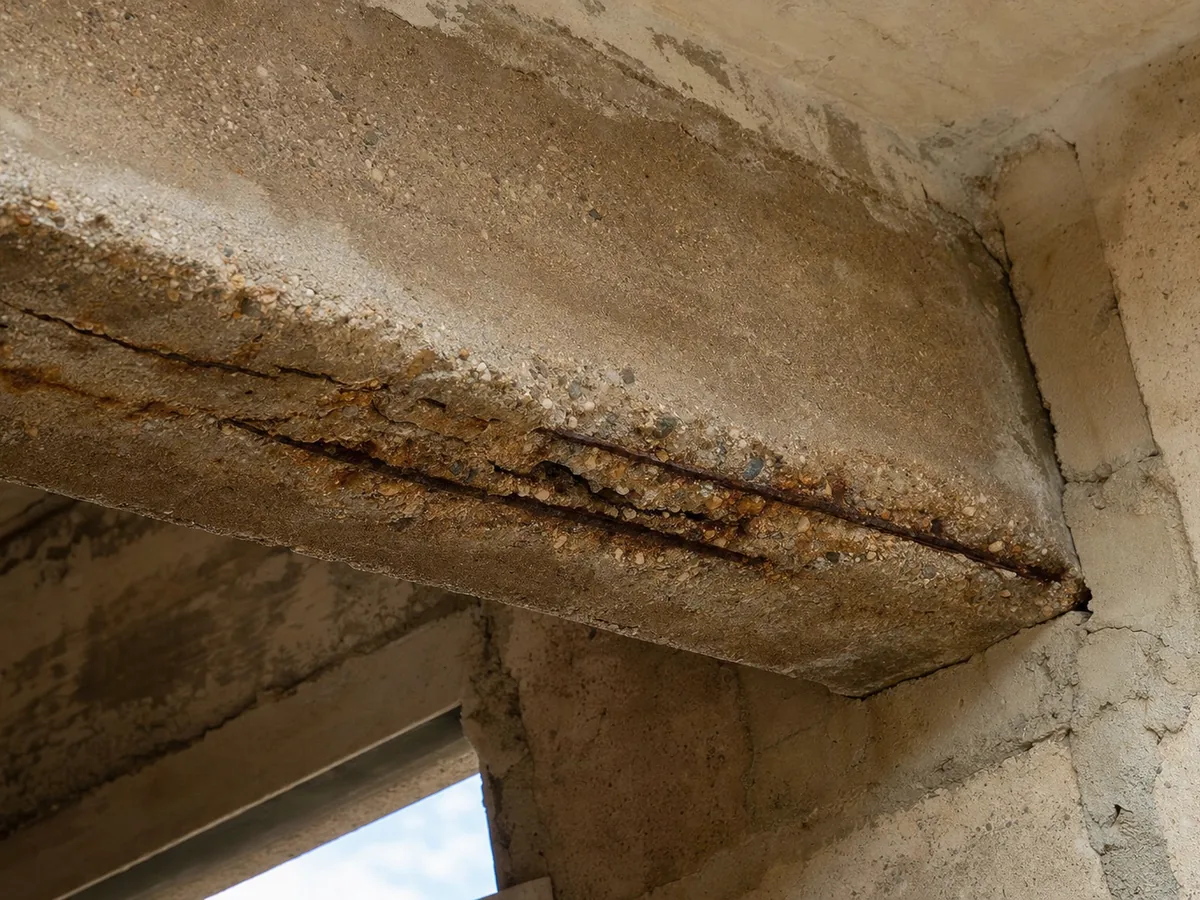
Aluminosis is the degradation of concrete made with aluminous cement, a material used in Spain between the late 1950s and late 1970s. It primarily affects the joists of floor slabs: the concrete becomes porous, loses strength, and turns brown. Key signs include rust stains, sagging slabs, and crumbling concrete. It requires technical diagnosis and, if confirmed, structural reinforcement.
If you live in a building constructed in Palma or any town in Mallorca between the 1960s and 70s, you've probably heard of aluminosis. It's one of the structural problems that most worries homeowners, and with good reason: it directly affects the building's safety. At Construcciones Armalutx, we've been rehabilitating structures all over the island since 1967, and aluminosis is one of the problems we've diagnosed and repaired most frequently. In this guide, we explain, without alarmism and with technical rigor, exactly what aluminosis is, which buildings are affected, how to detect it early, and what solutions exist to make your home safe.
What is aluminosis?
Aluminosis is the progressive degradation of concrete made with aluminous cement, a binder used for its rapid setting and high initial strength. Over time, and especially in warm and humid environments, this concrete changes its internal structure, becomes more porous, and loses much of its load-bearing capacity. This is why it is popularly known as "concrete disease.".
The origin lies in the material's chemistry. The calcium aluminate crystals that gave concrete its strength undergo a transformation over time (called conversion) that increases porosity, allowing moisture and air to penetrate, and consequently, the reinforcing steel begins to oxidize. The result is an increasingly weaker slab. It is precisely because of this behaviour that aluminous cement is currently... prohibited for structural use in Spain through Structural Code, which replaced the old EHE Instruction. Organisations such as the Eduardo Torroja Institute of Construction Sciences (IETcc-CSIC) they have been studying this pathology and its treatments for decades.
Which buildings have aluminosis?
Buildings at risk of aluminosis are those constructed roughly between 1950 and 1975 with prefabricated aluminous cement concrete beams. Not all buildings from that period are affected, but this is the group where the problem is most concentrated. In Mallorca, many of the apartment blocks built in the 1960s and 70s in Palma, and in towns like Inca, Manacor, and Llucmajor, fall into this age range.
Why was it used so much? During the height of the development boom, construction had to be fast, and aluminous cement reached high strengths in just a few hours, which accelerated the manufacture of prefabricated beams. The problem affected thousands of buildings throughout Spain, with a particularly high incidence in Barcelona, Madrid, Valencia, and Bilbao. Just because a building dates from that period doesn't mean it has aluminosis: it depends on the beam manufacturer and, above all, on exposure to humidity. If you have any doubts about an old building, at Armalutx, construction company in Mallorca with over 50 years of experience, we can guide you before you take any step.
How to detect aluminosis?
Aluminosis is detected by combining visual inspection with laboratory tests. At first glance, the most characteristic sign is colour: healthy concrete is grey, while that affected by aluminosis turns brown or dark brown. This is accompanied by rust stains, cracks in the joists, and sagging or deflection in the ceilings. Even so, only a test confirms the diagnosis.
These are the most common signs you can recognise at home and what they indicate:
| Signal observed | What does it indicate? | Urgency |
|---|---|---|
| Brown or tan concrete in the joists | Possible presence of aluminous cement | High – requires testing |
| Rust stains or brown rings on the roof | Humidity and corrosion of reinforcements | Medium-high |
| Longitudinal cracks along the joists | Loss of resistant section | High |
| Arrows, roofs that "give way" or doors that rub | Advanced structural deformation | Very high – act now |
| Concrete that crumbles or pulverizes upon touch | Severe degradation of the material | Very high |
If you recognise several of these signs at once, a professional evaluation is advisable. A specialist in structural reinforcement work in Mallorca can differentiate in a few minutes between a scare and a real problem.
How is aluminosis diagnosed?
A technician performs a definitive diagnosis of aluminosis by extracting a sample of the concrete and analysing it chemically. The reference test in Spain is the oxin method, which confirms whether the concrete contains aluminous cement. The complete process usually costs around €240 plus VAT, and the technical report is delivered within a few days.
The diagnostic steps are as follows:
- Visual inspection of the slab and location of the suspicious joists.
- Extraction of a small sample of the concrete from the beam (the well-known "test").
- In situ phenolphthalein test to measure carbonation and the state of protection of the armor.
- Laboratory test of oxin to determine the presence of aluminous cement.
- If the result is inconclusive, X-ray diffraction (XRD) analysis is used to confirm it.
- Drafting the technical report with the extent of the damage and the recommended measures.
The oxine method is not new: the Materials Laboratory of EPSEB-UPC it has been used for over 25 years, with tens of thousands of analyses performed and a reliability exceeding 99.7% (%). It is, by far, the safest way to resolve any doubts.
Is aluminosis dangerous?
Yes, aluminosis can be dangerous if left untreated because it reduces the load-bearing capacity of floor slabs. This doesn't mean a building with aluminosis will collapse tomorrow; it means its structure gradually loses stability and requires monitoring and, in many cases, reinforcement. Detected early, it's a perfectly treatable condition.
The case that put aluminosis on the map in Spain was the Turó de la Peira neighbourhood in Barcelona. On 11 November 1990, a building on Carrer Cadí partially collapsed and a resident died when the floor of her home gave way. Thousands of flats were inspected as a result: between 1990 and 2004, 11 blocks with 142 buildings were renovated or demolished in that area alone. It was an extreme case, the result of years of deterioration without action. The lesson is not panic but the opposite: with a timely diagnosis and the safety measures set by the Technical Building Code, the risk is controlled. It's important not to confuse every crack with aluminosis; if you're worried, here we explain when the Cracks in walls: when are they dangerous.
How is aluminosis repaired?
Aluminosis is repaired by reinforcing or replacing the affected structural elements, so that the load no longer depends on the degraded material. The most common approach is to reinforce the floor slab with new structures or replace the damaged joists. In severe and widespread cases, a complete reinforcement of the building may be necessary, and demolition is only considered in very extreme situations.
The most frequent interventions are:
- Reinforcing the slab without removing the joists, incorporating metal profiles or connectors that bear the load.
- Replacement of the affected joists, one by one, when the damage is localised.
- Reinforcement with new concrete about the existing structure; we'll tell you all about it in detail in structural reinforcement with concrete.
- Humidity control (ventilation, waterproofing of roofs and bathrooms) to slow the progression of the damage.
Costs vary greatly depending on the scope. A minor or cosmetic repair can range from €500 to €1,000, while structural reinforcement starts at around €5,000 to €10,000 and increases depending on the surface area and the number of joists. At Armalutx, we work as always: with a fixed price quote and no surprises, after inspecting each floor slab, if the building also has problems at its foundation, we assess whether it needs a foundation underpinning, another common problem in old buildings.
When is it NOT aluminosis
Not all stained or cracked concrete has aluminosis. These are the cases that are most often confused with it:
- Carbonation of concrete. Many old buildings exhibit corrosion of the reinforcing steel due to the normal carbonation of the concrete over time, even without the presence of aluminous cement. In these cases, the concrete remains grey.
- Dampness and leaks. A brown stain on the ceiling could be from a leak in the roof or an overhead bathroom, not from the structural material.
- Chloride corrosion. In coastal areas of Mallorca, the marine environment and salts can oxidize the reinforcement even if the concrete is completely sound.
- Aesthetic or retraction fissures. Fine cracks in partitions and plasterwork that do not affect the structure and usually have minor causes.
The only way to distinguish concrete with aluminosis from these other problems is through laboratory testing (oxine and, if necessary, XRD). When in doubt, a professional diagnosis is better than a guess.
Frequently asked questions about aluminosis
How can I tell if my apartment in Mallorca has aluminosis?
To determine if your apartment has aluminosis, a technician must inspect the joists of the floor slab and take a concrete sample for analysis using the oxin method. Visual clues (brown concrete, rust stains, cracks) can be helpful, but they are not sufficient. In buildings in Palma and Mallorca from the 1960s and 70s, it is advisable to have the test done before buying or renovating.
Can a building with aluminosis still be inhabited?
In most cases, a building with aluminosis can remain habitable while reinforcement is planned, provided a qualified professional has assessed the structure's condition. Aluminosis progresses gradually, not overnight. Only if the report detects an imminent risk are urgent measures recommended, such as shoring or temporary evacuation of the affected area.
How much does it cost to repair aluminosis?
The cost of repairing aluminosis depends on the extent of the damage. A minor repair can cost around €500-€1,000, while structural reinforcement of floor slabs starts at around €5,000-€10,000 and increases depending on the surface area and the number of joists affected. The correct approach is to first diagnose the problem with the oxin test and then provide a quote based on actual data, not estimates.
Is there a definitive cure for aluminosis?
Yes. Aluminosis can be permanently resolved by reinforcing or replacing the affected structural elements and controlling the humidity that accelerates the process. Once the floor slab is reinforced, the load no longer depends on the degraded concrete, and the building regains its structural integrity. The key is to act based on a technical diagnosis and not apply superficial patches that mask the problem.
Does aluminosis affect the value of a home?
Yes, untreated aluminosis reduces a property's value and can complicate its sale or obtaining a mortgage. Conversely, a reinforced building with a current technical report regains its appeal and reassures buyers. Therefore, whether you're looking to sell or have just bought, it's advisable to diagnose aluminosis and, if present, have it repaired with a guarantee.
—
Do you suspect your building in Palma or anywhere in Mallorca may have aluminosis? At Construcciones Armalutx, we have been diagnosing and resolving these types of problems since 1967, with over 1,500 projects under our belt and a 99% customer satisfaction rate. Contact us for an honest assessment of your structure and learn about our service structural reinforcement work in Mallorca. We are available by phone at +34 625 16 47 18, via WhatsApp, or at info@armalutx.com, with no obligation and no surprises. Before deciding on the scope of the work, it's helpful to know How much does it cost to reinforce beams with mecanovigas? and what does that price include?.