A crack is dangerous when it is more than 3 mm wide, goes right through the wall, follows a diagonal or stepped pattern, or grows over time: it usually signals a structural problem. It is superficial (and purely cosmetic) if it is less than 1 mm wide, fine and vertical, and stays stable. If in doubt about cracks in load-bearing walls, stop decorating and call a professional.
Seeing cracks in your home's walls is frightening, and rightly so: some are harmless, while others indicate structural damage. The problem is that, at first glance, a paint crack and a serious fracture can look very similar. In this guide, we'll teach you how to read a crack—its width, direction, and progression—to determine when it's merely cosmetic and when action is needed. In Mallorca, with its buildings made of marès stone, 1960s-era concrete, and unforgiving salty humidity, distinguishing a dangerous crack from a minor one can save you a major scare. Let's take it step by step, without being alarmist but with a thorough understanding.
When is a crack in the wall dangerous?
A crack in a wall is dangerous when it meets at least one of these criteria: it is wider than 3 mm, runs across the wall from side to side, forms a diagonal or stepped pattern, appears in a load-bearing wall, beam, or pillar, or changes size over several weeks. The wider, deeper, and more active the crack, the greater the structural risk.
These are the warning signs you shouldn't ignore:
- Width greater than 3 mm or that continues to grow (measure with a ruler and mark the ends with a pencil and date).
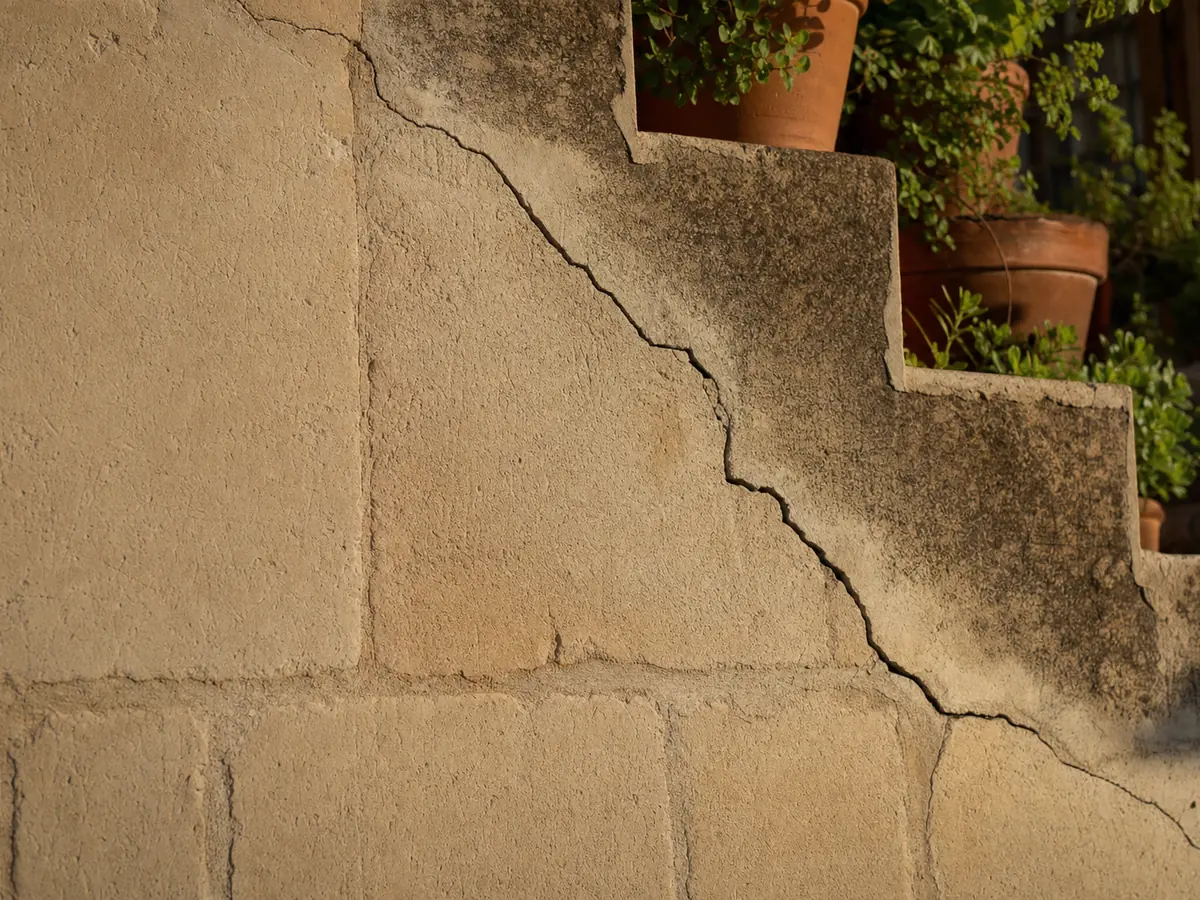
- Diagonal or stepped direction following the mortar joints of the factory.
- The crack runs through the entire thickness of the wall: light enters or you can see the other side.
- It appears in load-bearing elements: load-bearing walls, pillars, beams or slabs.
- It is accompanied by doors and windows that get stuck, warped floors, or uneven pavement.
- It sheds rust, dust or pieces of concrete, a sign of possible corrosion of the reinforcement.
If you recognise several of these signs, don't cover it up with putty: what you need is an assessment of Structural reinforcement in Mallorca. The very Technical Building Code (DB-SE) it requires that the structure behave safely in the face of foreseeable actions; when a crack indicates that this margin has been exceeded, the diagnosis is a matter for a technician.
What types of cracks are there?
Cracks are primarily classified by their orientation, as the direction reveals the cause. Vertical, thin cracks are usually due to shrinkage; horizontal, diagonal, or stepped cracks are the most concerning, as they indicate lateral thrust or ground settlement. It is also important to distinguish between a fissure (less than 1 mm, superficial, and aesthetically pleasing) and a crack (wider, deeper, and potentially structurally damaging).
| Type of crack | Probable cause | Gravity |
|---|---|---|
| Vertical and thin | Shrinkage of plaster or mortar, slight settling | Low (monitor) |
| Wide vertical (>3 mm) | Significant foundation settlement | Medium-high |
| Horizontal | Lateral pressure from the soil, moisture, or overload on the load-bearing wall | High |
| Diagonal (at 45°) | Differential settlement of the ground | High |
| Staircase (brick joints) | Foundation movement, partial subsidence | Very high |
Staircase cracks and diagonal cracks are red flags: they indicate that one part of the building is moving relative to another. Each pattern requires a different diagnosis, and we'll explain it in detail in What structural reinforcement techniques exist?.
Why do cracks appear in the walls?
Cracks in walls appear when a material is subjected to excessive stress: the ground settles, the wall pushes, the concrete deteriorates, or water seeps in where it shouldn't. The four most common causes are ground settlement, dampness, structural movement, and, in older buildings, aluminosis.
Ground settlement. Every building settles a little after completion; the problem arises when the settling is uneven (differential settlement), with one part settling more than another, pulling on the walls. In Mallorca, clay soils and areas close to the sea contribute to these movements.
Humidity. Water is the silent enemy. Rising damp, roof leaks, or a burst pipe cause materials to swell, reinforcements to rust, and cracks to appear, often horizontal and with surrounding stains.
Structural and thermal movement. Materials expand and contract with heat and cold; without well-resolved expansion joints, this tension ends up cracking facades and partitions.
Aluminosis. In buildings erected between 1950 and 1970 with aluminous cement, the concrete loses strength over the years and with humidity, something especially critical under the island's marine climate.
Spain's housing stock is old — a large part of it was built during the boom of the sixties, according to data from National Institute of Statistics—and many of these pathologies are surfacing right now, half a century later. The good news is that they exist public aid for building rehabilitation from the Ministry of Housing and Urban Agenda that can cover part of the intervention.
Aluminosis: the crack that reveals diseased concrete
Aluminosis is the degradation of concrete made with aluminous cement, widely used in Spain between 1950 and 1970 due to its rapid setting time. Over time and with exposure to humidity, the beams lose strength, become porous, turn a brownish-orange colour, and develop rust stains and cracks. It is one of the most serious structural pathologies a building can suffer.
It's not a theoretical problem: the collapse of a block in Turó de la Peira, Barcelona, in 1990, brought the issue to light; and in 2024, the main residence of the 12 de Octubre Hospital in Madrid was demolished for the same reason. Detecting it isn't easy, because at first glance it's easily mistaken for dampness; it requires a combination of soil sampling, laboratory analysis, ultrasound, and tests such as the oxin test. Organisations like the Eduardo Torroja Institute of Construction Sciences (IETcc-CSIC) they have been studying these concrete pathologies for decades. We explain how to recognise them step by step in What is aluminosis and how to detect it.
How are structural cracks repaired?
Structural cracks aren't fixed by simply patching them up: first, a technician diagnoses the cause, and then the root cause is addressed. Depending on the situation, cracks are repaired with staples or metal keys, resin or mortar is injected, beams and pillars are reinforced, or the foundation is underpinned when the problem originates in the ground. Only then is the crack sealed and plastered.
The cost varies considerably. Repairing a superficial crack in a facade costs around €10-20/m² in 2026, while foundation underpinning starts at around €186/m³ and rehabilitation due to aluminosis can reach tens of thousands of euros. That's why early diagnosis is cheaper: a crack detected in time rarely becomes a major project. If you want to understand the options, take a look how to reinforce a house that is already built or, when the origin is underground, what does it consist of foundation underpinning.
At Construcciones Armalutx, we've been reinforcing buildings throughout Mallorca since 1967, specialising in older structures. If a crack is keeping you up at night, a timely inspection will give you peace of mind and prevent bigger problems.
When NOT to be alarmed by a crack
Not everything that cracks is a structural problem. Most of the marks we see at home are cosmetic and can be fixed with filler and paint. These are the cases where you can breathe easy (although it's a good idea to keep an eye on them from time to time):
- Retraction cracks. They appear in the plaster or new mortar as it dries; they are very fine (less than 1 mm), vertical or cobweb-like, and do not grow.
- Microcracks in the paint or the textured finish. Superficial cracks in the finish layer, without depth; they are sanded and repainted without further ado.
- Cracks in the partition-ceiling joint. Non-load-bearing partitions move slightly relative to the floor slab; they usually reopen due to expansion and do not compromise the structure.
- Old and stable cracks. A crack that has remained the same for years, does not exceed 1-2 mm and does not evolve, has usually "rested" and only requires a good aesthetic seal.
Frequently asked questions about cracks in walls
At what size (in millimetres) does a crack in the wall become dangerous?
As a general rule, a crack in a wall smaller than 1 mm is usually a superficial, insignificant crack. Cracks between 1 and 3 mm should be monitored and noted if they grow. Cracks of 3 mm or more, or those that go through the entire wall, are considered potentially structural and should be inspected by a professional, especially if they appear in a load-bearing wall, beam, or column.
How can I tell if a crack in the wall is still growing?
To determine if a crack is active, mark both ends with a pencil and note the date, or place a plaster gauge across the crack. If the gauge breaks or the marks separate within a few weeks, the crack is evolving and there is active structural movement. A crack that remains unchanged for months is usually stable and of much less concern.
Can cracks in walls appear due to dampness?
Yes. Dampness is one of the most frequent causes of cracks in walls: water from leaks, capillary action, or burst pipes swells the materials and corrodes the concrete reinforcement, which, as it expands, causes the coating to burst. These are usually horizontal fissures and cracks accompanied by stains, mould, or peeling paint. Addressing the source of the dampness is always the first step before repairing.
Is a stairwell crack in a brick wall dangerous?
The stepped crack, which follows the mortar joints between bricks diagonally, is one of the most serious. It usually indicates differential settlement: part of the foundation has shifted and is pulling on the masonry. If the mortar gap exceeds 1.3 cm, it requires immediate attention and a diagnosis by a structural engineer before any repairs.
When should I call a professional about a crack?
Call a professional if the crack is wider than 3 mm, is diagonal or stepped, goes through the wall, appears in load-bearing elements, or grows over time. Also call a professional if you notice doors rubbing together, uneven floors, or rust on the concrete. An early inspection by a construction company in Mallorca specialised in structural reinforcement prevents much more expensive and complex repairs.