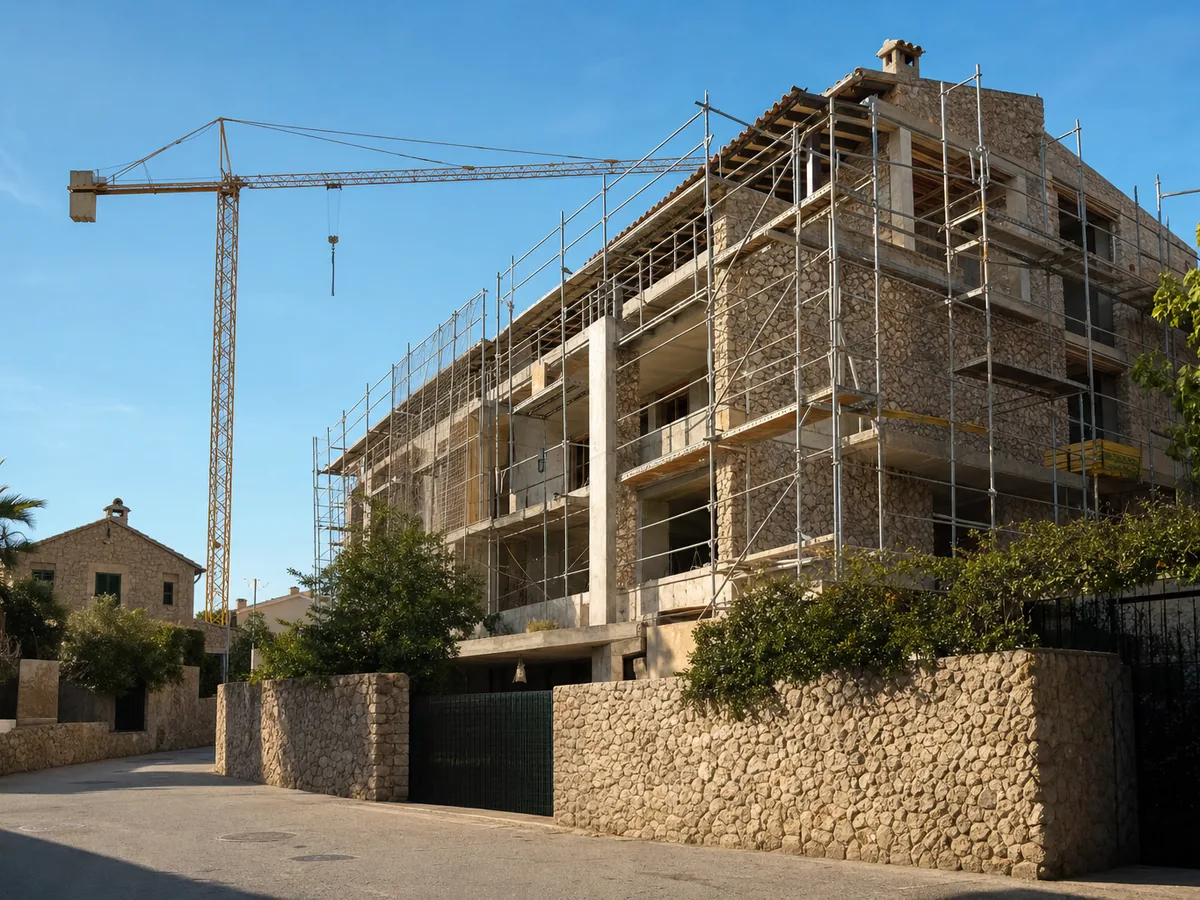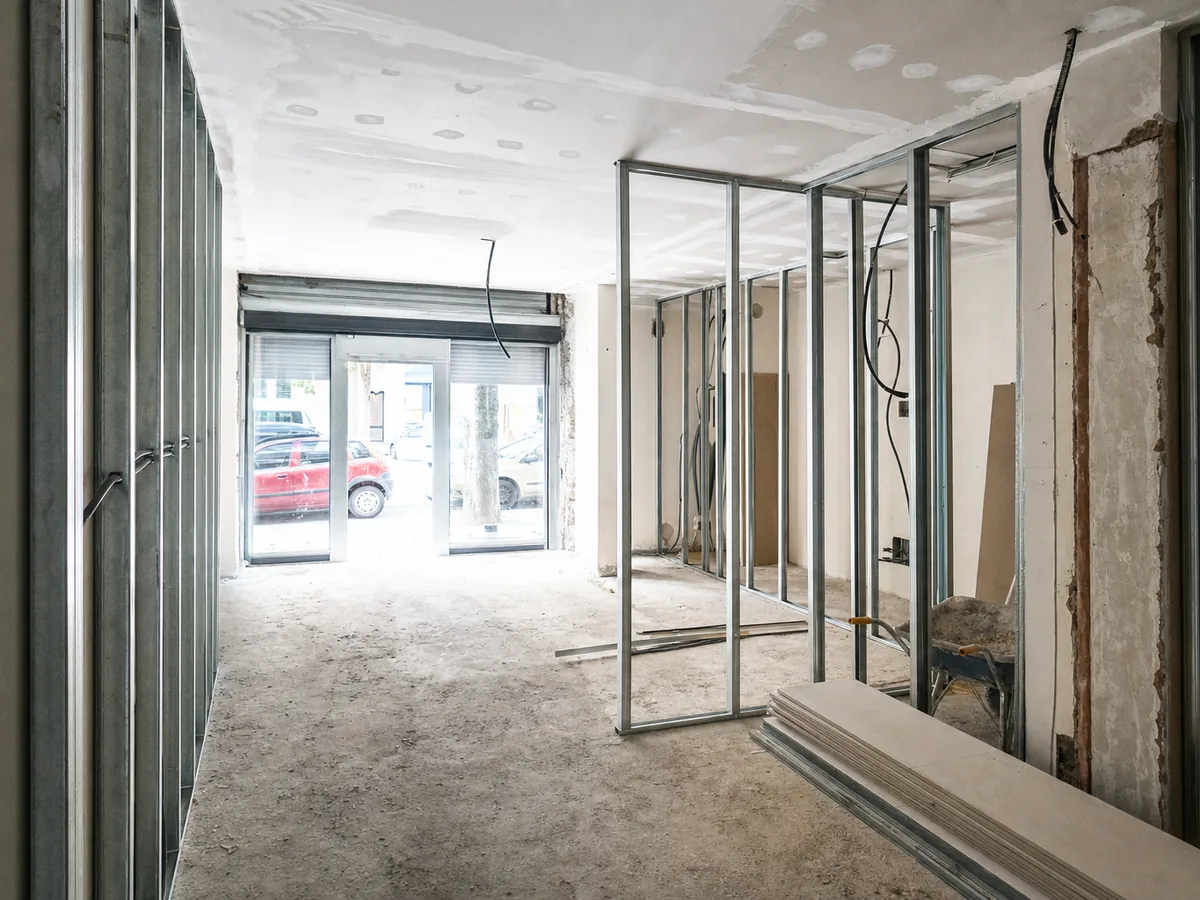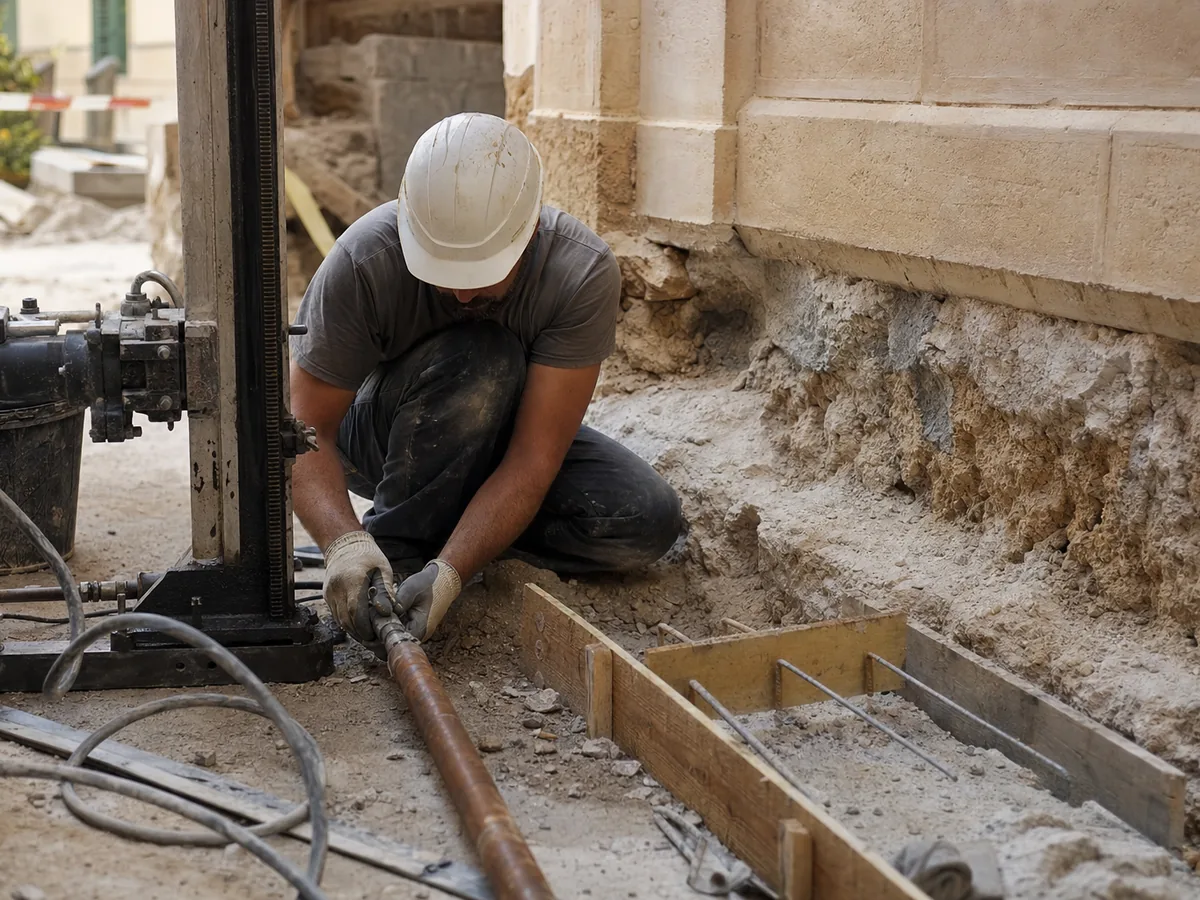
Foundation underpinning strengthens or extends the foundations of an existing building when the ground gives way and settlement appears. It is needed when there are diagonal cracks, doors that stick or sunken floors. The main methods are micropiles, injection of expanding resins or jet grouting, and underpinning in sections with concrete. The guide cost in 2026 starts at around €70-90 per metre of micropile or €188/m³ of concrete, always tailored to the job.
When an old house starts to "talk"—a crack that grows, a door that no longer closes, a corner that sinks—the problem is often not in the wall, but deeper down: in the foundation. Foundation underpinning is the technique that restores stability to a building whose original support has ceased to function. In Mallorca, we see it daily in stone houses, buildings made of marés stone in historic centres, and homes built decades ago on land that has changed over time. In this guide, we explain what it is, how to recognise the signs, what methods exist, and its approximate cost in 2026.
What is foundation underpinning?
Foundation underpinning is the set of techniques used to reinforce, extend, or deepen the foundation of an existing building to transfer its loads to firmer ground. In practice, it involves moving the weight of the structure from foundations that have failed to others with a larger surface area or to a deeper, more competent stratum.
It's not the same as building from scratch: you're working beneath a building that's still standing, with the live load on top of it. That's why it's a delicate engineering project, requiring geotechnical studies, structural calculations, and phased execution. Foundation reinforcement can be applied to footings, load-bearing walls, or slabs, and it always begins with a thorough diagnosis: first, you understand why the ground has settled, and only then decide how to underpin it. Everything starts with a good understanding of the soil: we detail this here When is a geotechnical study mandatory in Mallorca? and how much does it cost?.
When is foundation underpinning needed?
Underpinning is necessary when the ground beneath the building can no longer support the loads and the structure experiences settlement, meaning it sinks unevenly. Signs of this appear in the walls and floors long before they appear in the foundations, so it's important to recognise them early. These are the most common warning signs that necessitate foundation underpinning:
- Diagonal cracks at 45° that originate at the corners of doors and windows and go up or down: the clearest symptom of differential seating.
- Cracks in staircase following the joints of the brick or block on facades and party walls.
- Doors and windows that rub together, get stuck, or are misaligned gradually.
- Sloping or sunken soils, skirting boards separated from the wall or gaps between frame and partition.
- Changes in the environment: excavations by a neighbour, a new basement, water leaks or variations in the water table.
- Increased loads: add a floor, change the use of the building or rehabilitate by increasing the weight.
If you notice several of these signs, especially if they worsen over time, it's time for a structural inspection. You can learn more about this topic in our guide on Cracks in walls: when are they dangerous, where we differentiate between harmless cracks and those that warn of a serious problem.
What underpinning methods exist?
There are three main types of underpinning methods: micropiles, jet grouting, and concrete underpinning. The choice depends on the soil conditions, the building's load, the depth of the firm stratum, and the potential invasiveness of the work. There is no single method that is universally applicable, but rather the one best suited to each specific problem.
The micropiles These are reinforced boreholes of small diameter (between 100 and 200 mm) that penetrate the existing foundation and anchor the loads in a deep, resistant stratum; they are the reference point for significant settlements and floor extensions. injection of expansive resins It consolidates and raises the ground without excavation: a resin is injected through holes of less than 30 mm, expanding more than five times its volume and improving the load-bearing capacity of the soil in seconds. It is clean and very respectful of historic buildings. jet grouting It mixes the soil itself with high-pressure cement grout to create columns of improved soil. And the underpinning by battens Extend the footing or wall in sections, excavating underneath and pouring concrete in successive phases.
| Underpinning method | When to use | Estimated cost 2026 |
|---|---|---|
| Micropiles | Significant seating, high loads, plant expansion, deep firm stratum | ~70-90 €/m of micropile (complete project: several thousand €) |
| Injection of expansive resins / jet grouting | Consolidate the ground under the foundation, moderate settlement, quick construction without excavation | Customised quote based on surface area and volume to be treated |
| Underpinning by layers (reinforced concrete) | To widen or deepen footings and load-bearing walls in old buildings | ~188 €/m³ of underpinning carried out |
All these systems are calculated and verified according to the Basic Document DB-SE-C on Foundations of the Technical Building Code, the standard that regulates the structural safety of foundations in Spain.
How is a foundation underpinning done?
Underpinning is always carried out in phases and with the building's load controlled, never all at once. The process begins with a geotechnical study that identifies the firm stratum and the cause of the settlement, continues with the calculation of the reinforcement, and ends with the supervised execution.
Micropiles are used to re-establish the points, drill through the old foundation, place the tubular steel reinforcement, and connect it to a pile cap that distributes the load. In the underpinning by sections, excavation is done in alternating segments—never the entire face at once—and each section is concreted and cured before the next one is opened. In resin injections, a laser level monitors the millimetre-precise elevation in real time to stop the injection at the exact point. This phased control is what differentiates a job well done from a dangerous botch job, and it is part of how to reinforce a house that is already built without compromising its stability.
How much does foundation underpinning cost?
The cost of foundation underpinning depends on the method, the depth of the firm ground, and the surface area to be treated, so it is always quoted on a case-by-case basis. As a guideline for 2026, one metre of reinforced micropile for underpinning costs around €70-90 depending on the diameter and reinforcement, and underpinning by foundation extension with reinforced concrete is around €188/m³ executed, according to the CYPE construction price generator.
In a real building, the price isn't determined by the unit cost, but by the number of points requiring underpinning, the length of micropiles, and the accessibility of the site. Therefore, a minor intervention can be resolved for a few thousand euros, while underpinning an entire old building with significant settlement reaches much higher costs. The essential preliminary geotechnical study typically costs between €650 and €800. Be wary of fixed-price quotes without a site visit or soil testing: underpinning is priced only after understanding the problem, not before.
When foundation underpinning is NOT necessary
Not all cracks indicate a foundation problem, and unnecessary underpinning is a waste of money. Often, what worries the homeowner is cosmetic damage or a problem with the finishes, which has nothing to do with the ground. Underpinning is usually unnecessary in these cases:
- Retraction cracks: fine and superficial microcracks that appear when mortar, plaster or concrete dries, without progression or evolution.
- Cracks in non-structural partition wallsThe partition walls do not support the building; their cracks are usually due to expansion or impacts, not settling.
- Stable and old cracksA crack that has remained unchanged for years and rarely grows indicates an active foundation.
- Damage from moisture or thermal expansion: stains, flaking and cracks associated with leaks or temperature changes, which are resolved on the surface.
Reasonable doubt is always resolved the same way: by placing markers and observing whether the crack evolves. If it doesn't move, it's almost never the foundation. A separate case is concrete degraded by What is aluminosis?, which affects the structure but is addressed differently than the underpinning of the ground.
Frequently asked questions about foundation underpinning
How long does a foundation underpinning last?
The duration of foundation underpinning depends on the method and the number of points to be treated. An injection of expansive resins can be completed in a few days because it requires no excavation and the reaction is immediate. Underpinning with micropiles or in sections takes several weeks, as it is carried out in controlled phases to avoid undermining the building. The preliminary geotechnical study and calculations add essential additional time.
Is it possible to live in the house during the foundation underpinning?
In most foundation underpinning projects, it is possible to remain in the home, especially with resin injection, which generates minimal dust and noise. Underpinning using battens or micropiles involves more construction and localised disruption, but rarely requires the entire house to be vacated. The decision depends on the scope and area of the work, and is always made by the responsible engineer after assessing safety during the construction.
Does foundation underpinning solve cracks permanently?
A properly executed foundation underpinning stops the settlement that causes cracks and permanently stabilises the building, provided the cause has been correctly diagnosed. Once the ground movement is halted, the cracks stop growing and can be repaired on the surface without reopening. Failure almost always stems from an incomplete diagnosis; therefore, a prior geotechnical study is essential.
Which underpinning method is best for an old building?
For old and heritage buildings, the injection of expansive resins is usually the most recommended underpinning method because it is minimally invasive, does not require large excavations, and respects the historical structure. When settlement is severe or new loads need to be supported, micropiles offer greater capacity. The final choice is determined by a soil study, according to the structural safety criteria of the Spanish Building Code (CTE).
Who can do a foundation underpinning?
Foundation underpinning must be designed and supervised by a qualified professional (an architect or engineer) and carried out by a construction company with experience in structural reinforcement. It is not just any renovation: a mistake when undermining the building can make the damage worse. At Construcciones Armalutx we work to criteria recognised by the Eduardo Torroja Institute of Construction Sciences (IETcc-CSIC) and we verify each solution according to the DB-SE-C of the Technical Code.
—
If your building shows cracks that are growing, sinking floors, or misaligned doors, don't wait for the damage to worsen. Construcciones Armalutx We have been reinforcing foundations throughout Mallorca since 1967, with over 1,500 projects and specialists in old buildings. We are a Trusted construction company in Mallorca that diagnoses first and then acts, without surprises. Discover all our structural reinforcement work in Mallorca or request an inspection by calling +34 625 16 47 18. We study your case and tell you, clearly, if you really need a reinforcement.